Volvo D13
2007–2026
The D13 covers a wide run of Volvo on-highway tractors, with major changes in fuel and aftertreatment equipment. Later D13 models use common-rail injection, and some recover exhaust energy through turbo compounding. An early VNL, a 2021 VNR and a later-generation VNL can all use D13 power. Describe the engine and emissions generation plus the installed turbo hardware when comparing repair prices or interpreting a fault report, rather than using a generic engine label alone.
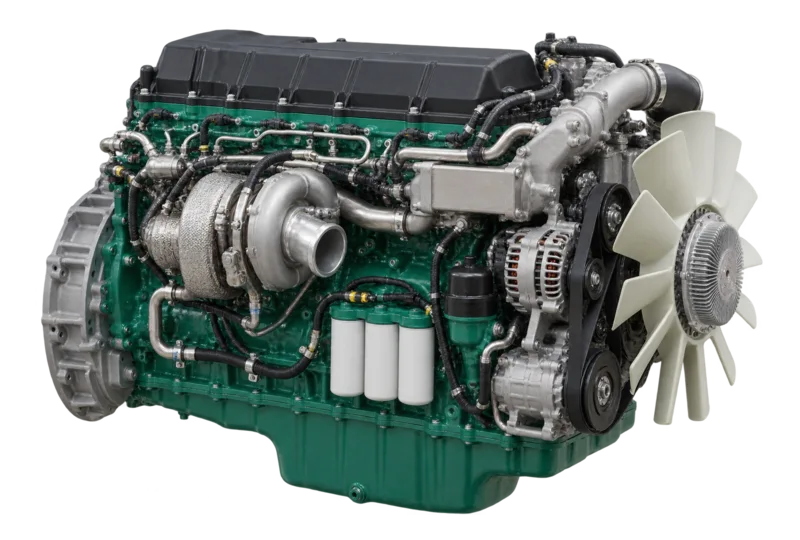
Key specifications
- Displacement
- 12.8 L (780 cu in)
- Configuration
- Turbocharged inline-six diesel; VGT and turbo-compound configurations depending on generation
- Fuel system
- Electronic direct injection; common rail on published later configurations
- Typical factory output
- 405–500 hp and 1,450–1,850 lb-ft in the published 2021 VNR series; other packages vary
- Peak torque
- 1,450–1,850 lb-ft for the 2021 VNR D13 ratings
- Bore × stroke
- 131 × 158 mm (5.16 × 6.22 in) in the cited VNR engine table
- Aspiration
- Variable-geometry turbocharger on the cited VNR configuration; turbo-compounding is documented separately for the D13TC
- Compression ratio
- 17:1 for the D13 in the 2021 VNR engine table
- Valvetrain
- Single overhead camshaft and four valves per cylinder in the cited VNR configuration
- Engine brake rating
- 500 hp at 2,200 rpm in the 2021 VNR
Where it was used
The D13 belongs to Volvo’s North American US07 engine generation and is documented through 2026. Volvo announced North American D13 turbo compounding in 2016 for 2017; D13TC and VGT availability vary by chassis and publication year.
- Volvo specified D13 power in VNL long-haul sleepers and day cabs.
- The earlier VNR regional platform offered D13 alongside D11, and the new VNR uses D13 power.
- Volvo’s high-demand VNX materials describe the D13 in later heavy-haul configurations.
Service life
1,200,000 milesOEM B50
Volvo’s 2021 North American VNR brochure lists a 1.2-million-mile B50 design target for its D11 and D13. The population design figure should be read alongside the individual tractor’s service history and measured condition.
For overhaul planning, use the VIN, engine build, duty cycle and the actual test results. Assess the installed fuel, cooling and air systems before agreeing to an engine teardown.
Typical problems and service checks
Turbo-compound versus main turbo
The power turbine on an applicable D13TC recovers exhaust energy downstream of the main turbocharger. Label each assembly separately in the work order so the finding or test result can be tied to the part being priced.
Match the oil system by generation
Volvo body-builder material documents changes to the separate bypass filter for specified D13 model years and turbo configurations. Confirm the actual assembly and the applicable filter and oil requirements before treating a diagram as universal.
Read exhaust tests with the right diagram
Keep the aftertreatment package, emissions year and what the truck was doing with a regeneration or SCR complaint. The right test starts from the exact installed sensors, exhaust routing and expected temperatures.
References
- Volvo North American US07 engine certification
- Volvo Trucks North America: MY2017 D11, D13 and D16 powertrain
- Volvo Trucks USA 2021 VNR brochure: engine tables and B50 figure
- Volvo Trucks USA: North American D11, D13 and D16 component layouts
- Volvo Trucks USA: D13 VGT engine release
- Volvo Trucks USA: VNX powertrain
- Volvo Trucks USA D13TC variant specifications