PACCAR PX-9
2013–2026
The 8.9-liter PX-9 spans local delivery and vocational work. Peterbilt explicitly offers it in the Class 8 Model 548 and the Model 520 refuse chassis. In those trucks, the engine may spend substantial time powering a body or idling between short trips. A useful diagnosis starts with engine hours, the exact body controls and the emissions configuration. Confirm the current rating and fuel-filter layout before applying a service bulletin, especially when the chassis has remotely mounted components.
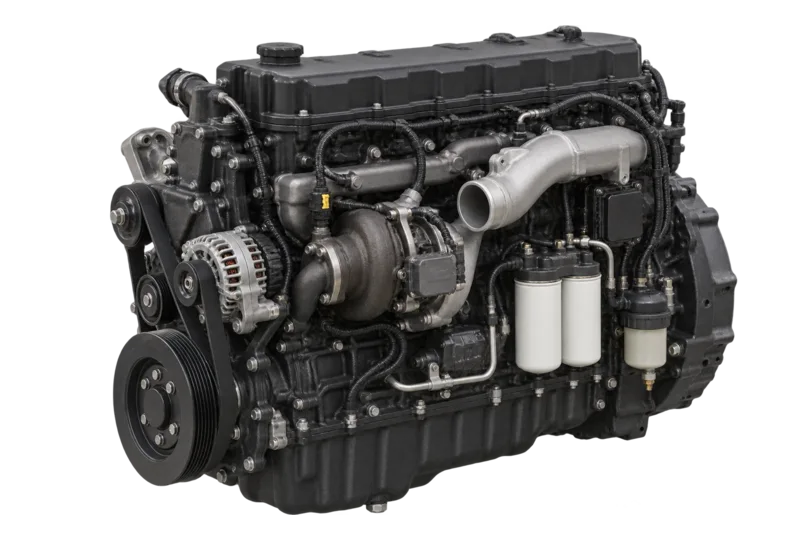
Key specifications
- Displacement
- 8.9 L
- Configuration
- Inline six-cylinder turbocharged diesel
- Fuel system
- Electronically controlled high-pressure common rail
- Typical factory output
- 260–450 hp and 860–1,250 lb-ft in PACCAR's product range; Peterbilt publishes up to 380 hp for the listed 520 fitment
- Peak torque
- 860–1,250 lb-ft (EPA 2021 specification)
- Bore × stroke
- 114 × 145 mm
- Aspiration
- Turbocharged and charge-air cooled
- Governed speed
- 2,100–2,200 rpm (EPA 2021 specification)
- Oil system capacity
- 29 US qt (EPA 2021 specification)
Where it was used
Kenworth announced the PX-9 for its 2013 lineup, including the T440 and T470, whose factory specifications offered Class 8 weight ratings. PACCAR lists the engine through the 2026 research cutoff.
- Peterbilt Model 520 low-cab-forward refuse truck.
- Peterbilt Model 548 Class 8 specialty trucks, whose factory sheet documents GVWR configurations up to 66,000 lb.
- Kenworth T440 and T470 in the 2013 PX-9 rollout, specifically configurations above the Class 7 weight limit. The factory lists configurations up to 68,000 lb.
Service life
≈680,000–910,000 milesClass 8 diesel rebuild benchmark
In the U.S. EPA rebuild survey, the two averages for Class 8 diesels were about 680,000 miles for a first in-frame rebuild and 910,000 miles for a first out-of-frame rebuild. These are comparison points for the vehicle class. A model-specific overhaul interval could not be verified. Ritchie Bros. reported 306,233 displayed miles and 13,604 engine hours for a 2019 Peterbilt 348 tri-axle dump truck with 70,000 lb GVWR and a 380 hp PX-9. This is one vocational inspection. The sale record gives no rebuild history.
Use hours and oil-analysis history to evaluate chronic oil use, verified crankcase pressure or declining hot oil pressure. Distinguish repeated idle-related aftertreatment work from evidence of internal wear.
Typical problems and service checks
Remote filter hose leakage or stall
Peterbilt recall 23PBF covers relevant PX-9 remote fuel-filter hose installations. If there is leakage or an unexplained stall, secure the truck and have the campaign checked by VIN. The engine name alone does not establish eligibility.
Long warm start after filter service
Check the fitted filter location and use the actual fuel system procedure. The work order should distinguish low-side supply and air entry from a rail pressure fault using the original heat-soak conditions.
Regeneration interruptions during body work
A route with frequent stopping or extended PTO use can change when the exhaust stays warm. Review completed and interrupted events, then compare the pressure and temperature evidence under the engine's documented test conditions.
References
- PACCAR PX-9 engine overview
- Kenworth factory introduction of PX-7 and PX-9 literature
- PACCAR PX-9 operator's manual
- Peterbilt Model 520 factory powertrain options
- Peterbilt Model 548 Class 8 specifications
- Peterbilt PX-9 hose recall 23PBF
- Kenworth T440 and T470 factory specifications and weight ranges
- Peterbilt EPA 2021 PX-9 spec sheet
- Ritchie Bros. original Peterbilt 348 vocational truck inspection
- U.S. EPA, Heavy-Duty Engine and Vehicle Standards Regulatory Impact Analysis, Table 2-10