PACCAR PX-8
2010–2013
The PX-8 was an 8.3-liter PACCAR diesel in Kenworth's T440 catalog. That truck straddled Classes 7 and 8, so the badge and engine tell only part of the story. A 66,000-pound tandem dump truck provides a documented Class 8 example. Its shifts could combine short road trips with prolonged PTO operation. For that work pattern, engine hours, loaded temperature and service records tell more about the truck's condition than the odometer alone. Use the engine data plate to choose emissions and parts information.
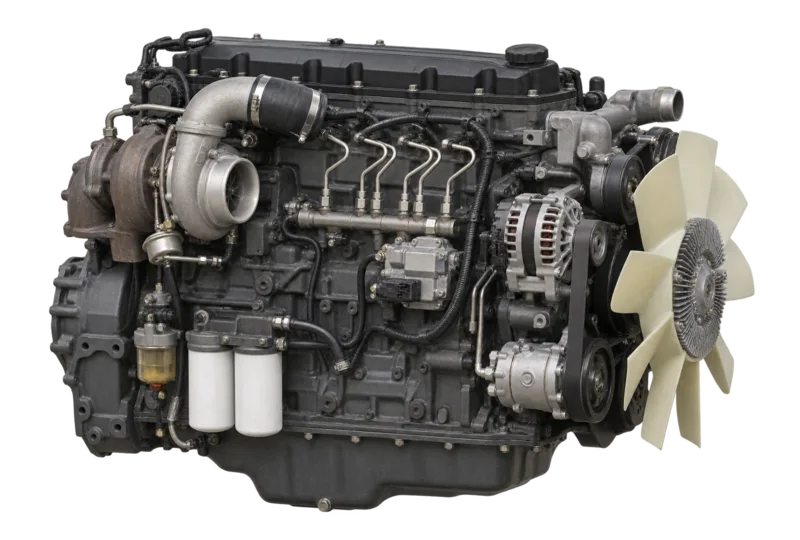
Key specifications
- Displacement
- 8.3 L (504.5 cu in)
- Configuration
- Inline-six diesel
- Fuel system
- High-pressure common rail on the documented EPA 2010 engine
- Typical factory output
- 260–350 hp (T440 catalog)
- Peak torque
- Up to 1,000 lb-ft (T440 catalog)
- Bore × stroke
- 114 × 135 mm
- Aspiration
- Turbocharged and charge-air cooled
Where it was used
2010–2013 is the documented Kenworth T440 window covered here. The 2013 truck carries a 2012 U.S. EPA engine label. Those are chassis and engine years respectively.
- Kenworth's 2010 T440 brochure lists the PX-8 and T440 configurations from 33,000 to 68,000 lb GVW. The applicable Class 8 truck has a GVWR above 33,000 lb.
- A U.S. 2013 Kenworth T440 6×4 tandem dump truck had a 330 hp PX-8, a 2012 engine emissions label and a 66,000 lb GVWR.
- A U.S. 2013 Peterbilt 348 water truck at 64,000 lb GVWR used a PX-8 and PTO-driven water pump.
Service life
≈680,000–910,000 milesClass 8 diesel rebuild benchmark
In the U.S. EPA rebuild survey, the two averages for Class 8 diesels were about 680,000 miles for a first in-frame rebuild and 910,000 miles for a first out-of-frame rebuild. These are comparison points for the vehicle class. A model-specific overhaul interval could not be verified. Adelman's advertised a run-tested 2012 PX-8 takeout from a Kenworth and reported 241,480 miles visible on its ECM. That unit's original duty and overhaul history are unavailable. Separately, Ritchie Bros. recorded 96,702 vehicle miles and 4,996 engine hours on a 66,000 lb GVWR T440 dump truck.
Compare crankcase pressure, hot oil pressure and the parts of the day spent at PTO speed. Verify any replacement record against the engine serial number before treating an ECM reading as mileage on original internals.
Typical problems and service checks
Hard start after a filter service
Record the filter work, priming steps and temperature. On this fuel system the shop can test the low-pressure supply and check for air before comparing commanded and measured rail pressure. Keep any high-pressure-system checks within the engine's service procedure.
Derate after extended idle or PTO
Save the warning sequence, time at PTO and last successful regeneration. For the EPA 2010 configuration, retrieve soot-load and exhaust-temperature history and verify that the intake and exhaust are intact. A regeneration request by itself leaves several possible faults open.
Power returns after short cooldown
Log actual boost and coolant temperature at the load that triggers the complaint, with the engine serial number and ambient temperature. A shop can pressure-test the charge-air path and compare control response with the cooling-fan history before removing the turbocharger.
References
- Kenworth original T440 model brochure
- PACCAR PX-8 operator's manual
- Ritchie Bros. original listing, US 2013 T440 Class 8
- Adelman's original inspection and ECM reading for 2012 PX-8
- Ritchie Bros. original 2013 Peterbilt 348 PX-8 water truck inspection
- U.S. EPA, Heavy-Duty Engine and Vehicle Standards Regulatory Impact Analysis, Table 2-10