Mack MP8
2007–2026
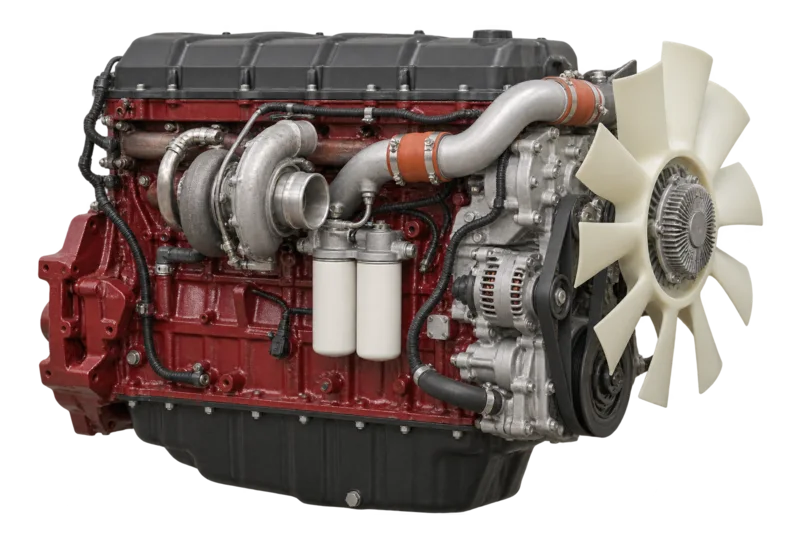
The MP8 carried Mack’s 13-liter engine into long-haul and demanding regional tractors. Major updates across its life included emissions hardware changes and common-rail injection on later generations. The MP8HE and associated long-haul packages add turbo compounding, which creates an additional power recovery circuit. Separate that architecture from the standard MP8 when comparing turbo, oil system and exhaust work. Both the truck build and the engine plate matter.
Key specifications
- Displacement
- 12.8 L, marketed as 13 L
- Configuration
- Turbocharged inline-six diesel; optional turbo compounding on specified MP8HE packages
- Fuel system
- Electronic direct injection, with common rail on documented later generations
- Typical factory output
- 415–505 hp in Mack’s published later specifications; rating and torque depend on year and package
- Peak torque
- 1,460–1,860 lb-ft in Mack’s published rating summary; a separate 505-hp MP8 exhibit is rated 1,900 lb-ft
- Bore × stroke
- 131 × 158 mm (5.16 × 6.22 in) in Mack’s MP8 specification table
- Aspiration
- Turbocharged; the MP8HE subfamily adds an exhaust power turbine for mechanical energy recovery
- Compression ratio
- 16:1 in the cited standard MP8 table; evaluate HE by its own build
- Engine brake rating
- 500 hp at 2,100 rpm in the cited MP8 specification table
Where it was used
The 13-liter Mack MP was announced for 2007 and the MP8 remains documented across later Mack applications. MP13’s arrival should not be read as an immediate across-the-line MP8 retirement.
- Mack documents the MP8 in the Anthem highway tractor during its long-haul product era.
- Mack published turbo-compounded MP8 ratings for its Super Econodyne long-haul package.
- MP8 engines are documented in multiple Mack vocational builds, so highway and severe-duty service schedules can differ.
Service life
≈680,000–910,000 milesClass 8 diesel rebuild benchmark
In the U.S. EPA rebuild survey, the two averages for Class 8 diesels were about 680,000 miles for a first in-frame rebuild and 910,000 miles for a first out-of-frame rebuild. These are comparison points for the vehicle class. A model-specific overhaul interval could not be verified.
An overhaul evaluation should account for duty cycle, oil history, blow-by or pressure checks, teardown measurements and turbo-compounding hardware as applicable. Mack’s overhaul coverage and current parts should be checked by serial.
Typical problems and service checks
Know which turbo device is in the estimate
On a turbo-compounded MP8, distinguish the main turbo from the exhaust power recovery hardware. Ask which observation points to the priced part and whether the concern was traced to the intake, conventional turbo or the compounding stage.
Control pressure versus supply
On a common-rail example, compare rail behavior and commanded pressure under the same conditions after verifying the supply. Earlier injection architecture calls for a different diagnostic path; the rating or family badge is insufficient.
Match aftertreatment generations
Before an exhaust estimate, identify the engine’s emissions generation and the installed aftertreatment box or boxes. A soot or SCR fault can reflect engine operation or a sensing and dosing issue, and the shop should document how each was assessed.
References
- Volvo Group: Mack’s 2006 highway and vocational lineup
- Volvo Group: Mack’s 2017 engine lineup
- Mack North America MP8 engine specifications
- Mack Anthem highway application
- Mack MP8 505-hp, 1,900-lb-ft example at ExpoCam
- Mack MP8 and MP8HE comparison
- U.S. EPA, Heavy-Duty Engine and Vehicle Standards Regulatory Impact Analysis, Table 2-10