Mack MP7
2006–2026
The MP7 brought Mack’s new 11-liter-class diesel into the Pinnacle and Granite lineups for 2006. It remained useful where tare weight, shorter routes and vocational crossover mattered. Early MP7s and later common-rail versions share the name while using different diagnostic and fuel system equipment. Start with the engine serial and emissions label when checking fuel delivery or ordering injectors, then verify that the service information matches the chassis in front of you.
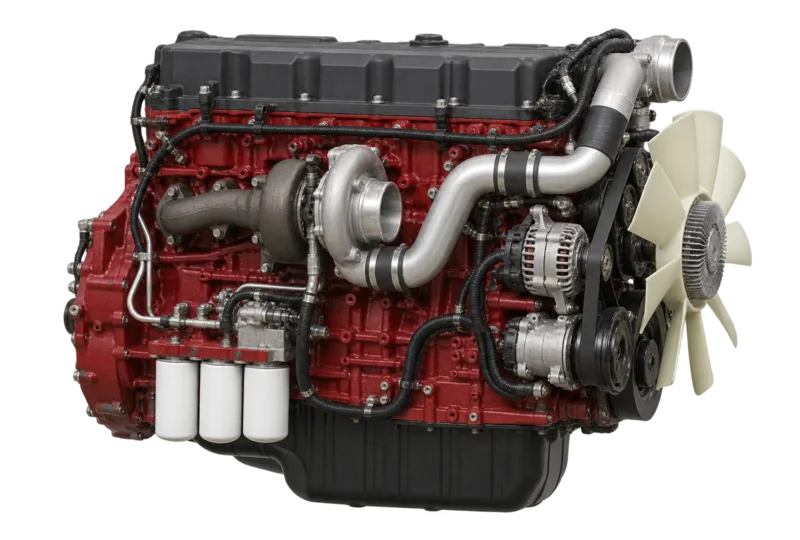
Key specifications
- Displacement
- 10.8 L
- Configuration
- Turbocharged inline-six diesel
- Fuel system
- Electronically controlled direct injection; common rail on redesigned 2017 and later specified builds
- Typical factory output
- 325–425 hp on the later lineup; documented MY2006 calibrations differ
- Peak torque
- 1,260–1,560 lb-ft in Mack’s later MP7 rating table
- Bore × stroke
- 123 × 152 mm (4.84 × 5.98 in) in Mack’s specifications
- Aspiration
- Electronically controlled variable-geometry turbocharger on the documented later configuration
- Compression ratio
- 16:1 in the cited Mack specification table
- Engine brake rating
- 420 hp at 2,100 rpm in the cited Mack configuration
Where it was used
MY2006 MP7 certification and model launch are documented. Later current-generation vehicles and documentation extend the family into the closing years of this reference. Confirm truck and emissions model years separately.
- Mack’s new 2006 Pinnacle highway tractor was designed around the 11-liter MackPower engine.
- MP7 ratings have also been used in road-going Granite builds where weight and vocational demand matter.
Service life
≈680,000–910,000 milesClass 8 diesel rebuild benchmark
In the U.S. EPA rebuild survey, the two averages for Class 8 diesels were about 680,000 miles for a first in-frame rebuild and 910,000 miles for a first out-of-frame rebuild. These are comparison points for the vehicle class. A model-specific overhaul interval could not be verified.
Mack supports MP-series overhaul and reman work. Compare blow-by, hot oil pressure and coolant and oil trends with the service information for the serial before pricing an in-frame or replacement engine.
Typical problems and service checks
Fuel delivery by generation
A later common-rail pressure trace needs a different interpretation from the measurements used on an earlier MP7. Write the injection configuration at the top of the job, and keep the supply-side and injection-side observations separate.
Cooling under low road airflow
Vocational and regional tractors can reach high load while moving slowly. Have the technician match coolant demand, fan response and the installed stack to the conditions where the temperature changed.
Engine braking behavior
Identify the brake hardware, gear and engine speed before ordering brake-related parts after a weak response. The enabling inputs and valvetrain checks vary by build and should be verified against the manufacturer’s procedure.
References
- Volvo Group: Mack’s 2006 highway and vocational lineup
- CARB MY2006 MP7 executive order
- Volvo Group: Mack’s 2017 engine lineup
- Mack North America MP7 engine specifications
- Mack published MP7 and MP8 HE product comparison
- U.S. EPA, Heavy-Duty Engine and Vehicle Standards Regulatory Impact Analysis, Table 2-10