Mack MP13 / MP13 HE
2025–2026
Mack introduced the MP13 and MP13 HE in the Pioneer era. Both are heavy-duty highway diesels, with different turbo hardware and application packages. The HE extracts exhaust power through its turbo-compound stage. Mack’s later EPA 2027 announcement is useful context for parts identification, because an early Pioneer and a future-generation truck can carry the same family name. Read the engine and emissions label and check the build record before comparing service procedures or ordering an assembly.
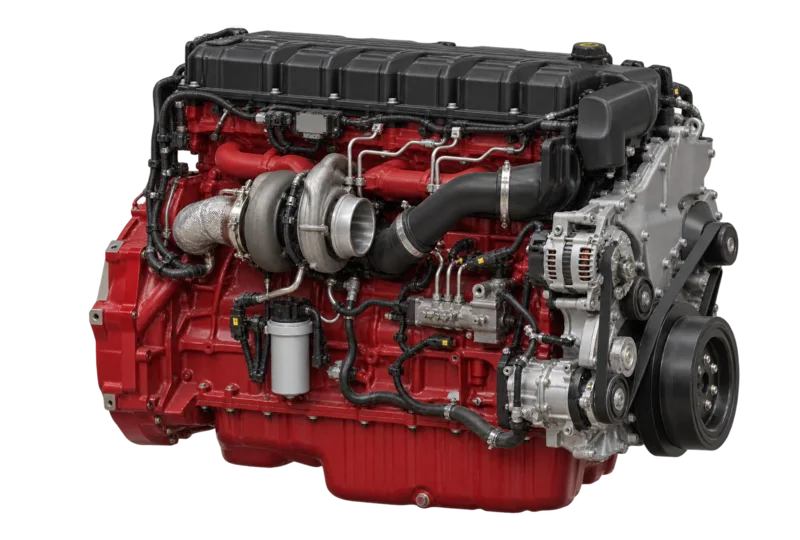
Key specifications
- Displacement
- 12.8 L, marketed as 13 L
- Configuration
- Turbocharged inline-six diesel; exhaust power turbine on MP13 HE
- Fuel system
- High-pressure common-rail direct injection
- Typical factory output
- 2025-series standard MP13 up to 515 hp; MP13 HE up to 505 hp in Mack’s variant-specific tables
- Peak torque
- 1,550–1,900 lb-ft in Mack’s standard MP13 technical table and 1,550–1,950 lb-ft in its HE table
- Aspiration
- Variable-geometry turbo on the standard 2025 MP13; fixed-geometry turbo and exhaust power turbine on the 2025 HE
- Compression ratio
- 18:1 in Mack’s 2025 MP13 and HE tables
- Maximum common-rail pressure
- 2,400 bar (about 34,800 psi) in both published 2025 variant tables
- Oil capacity
- 39.5 L dry fill; 35 L at service with filters in the two cited 2025 layouts
Where it was used
North American Pioneer production and first U.S. deliveries began in 2025. The interval covers the 2025-series MP13 hardware through the 2026 catalog cutoff. Mack’s separate EPA 2027 design was announced in 2026 and belongs to the next emissions era.
- The 2025 Mack Pioneer was produced in Pennsylvania for North American long haul and went into U.S. customer service in 2025.
- The MP13 and MP13 HE are documented Pioneer powertrain variants. Confirm the engine’s exact configuration separately from the cab and trim.
Service life
≈680,000–910,000 milesClass 8 diesel rebuild benchmark
In the U.S. EPA rebuild survey, the two averages for Class 8 diesels were about 680,000 miles for a first in-frame rebuild and 910,000 miles for a first out-of-frame rebuild. These are comparison points for the vehicle class. A model-specific overhaul interval could not be verified.
A planning estimate should use the manufacturer’s service requirements, the truck’s history and teardown evidence. Match the serial, warranty status, calibration and exhaust hardware before pricing major repair.
Typical problems and service checks
Confirm the HE hardware
Identify the standard turbo and, on an HE, the additional exhaust energy-recovery hardware. Ask which part was tested and how the shop separated pressure-side leakage, exhaust restrictions and turbo-compound faults.
Start with the engine’s build record
Put the engine serial, vehicle VIN and emissions data on the first page of a major repair. Mack’s 2025 and EPA 2027 public product information cover different designs even though the MP13 name continues.
Keep the fuel evidence clean
A fuel complaint on common rail calls for a controlled diagnostic sequence. Compare supply condition, commanded and reported values and the tests that point to the suspected component before authorizing high-pressure fuel work.