Mack MP10
2008–2017
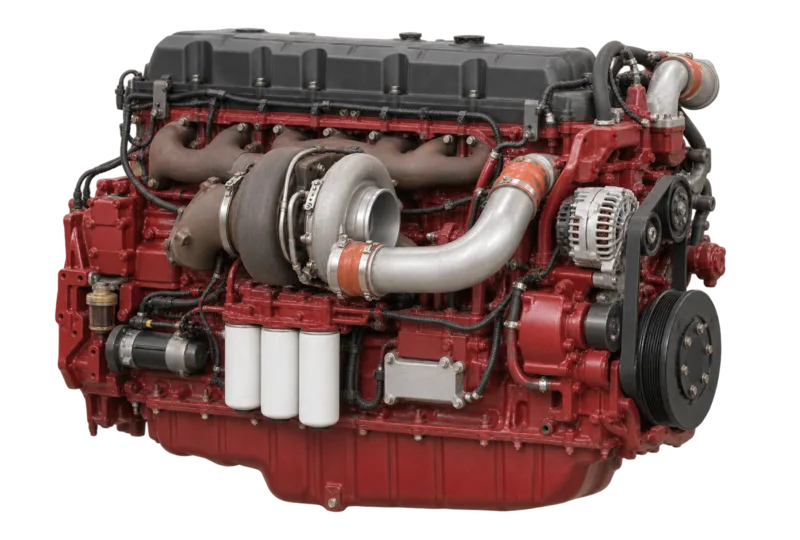
The 16-liter MP10 was the engine that distinguished Titan by Mack for major transport and construction work. Its factory output went to 605 horsepower and the top documented 2017 torque rating exceeded 2,000 lb-ft. With few comparable U.S. applications, the tractor and the installed emissions generation play a large role in selecting replacement parts. Verify the current support for the actual engine and chassis before setting a firm heavy-haul repair schedule.
Key specifications
- Displacement
- 16 L class
- Configuration
- Turbocharged inline-six diesel
- Fuel system
- Electronically controlled direct injection; follow the engine serial’s fuel system procedure
- Typical factory output
- 515, 565 and 605 hp at launch; up to 2,060 lb-ft in Mack’s 2017 lineup
- Peak torque
- Up to 2,060 lb-ft in Mack’s MY2017 Titan lineup
- Aspiration
- Turbocharged and charge-air cooled in the Titan engine installation
- Oil pan capacities
- 42 L (44 qt) or 52 L (55 qt) by pan in Mack’s maintenance guide for 2010–2016 engines
- Launch emissions era
- North American US07 at the 2008 Titan launch; verify later US10/OBD configuration by serial
Where it was used
Mack announced Titan and its MP10 in March 2008 and expected initial deliveries late that year. The 2017 engine lineup still covers the MP10; the interval reflects the end of the U.S. Titan and 16-liter Mack era around 2017.
- The Titan by Mack tractor was launched for North American heavy-haul and severe-duty transport.
- Mack continued to specify the MP10 as standard in Titan for the documented 2017 lineup.
Service life
≈680,000–910,000 milesClass 8 diesel rebuild benchmark
In the U.S. EPA rebuild survey, the two averages for Class 8 diesels were about 680,000 miles for a first in-frame rebuild and 910,000 miles for a first out-of-frame rebuild. These are comparison points for the vehicle class. A model-specific overhaul interval could not be verified.
Check whether the original block and crank are rebuildable and secure availability for the identified heads, fuel equipment and emissions parts before committing a Titan to major work. Lead time and the usable core condition may drive the choice.
Typical problems and service checks
Protect the heavy-haul cooling baseline
Have the shop separate the engine’s cooling response from the truck’s road speed and trailer load. A cooling-system estimate is easier to interpret if the work order includes fan activity, operating conditions and the history of coolant service.
Check chassis-specific access
Titan packaging affects which parts are reachable with the engine in place. Record what the shop can measure in the chassis, which work calls for removal and which attachments transfer to an identified replacement.
Use the right emissions documentation
A US07 launch configuration and a later truck can have different emissions equipment and control strategy. Save the emissions label, the chassis layout and original fault capture before deciding whether the exhaust complaint begins inside the MP10 or downstream.
References
- Volvo Group: North American MP10 launch and Titan installation
- Volvo Group: Mack MY2017 MP-series engine lineup
- Mack/Volvo: Model year 2016 and 2017 diagnostic applicability
- Mack oil service table including MP10 42 L and 52 L pans
- U.S. EPA, Heavy-Duty Engine and Vehicle Standards Regulatory Impact Analysis, Table 2-10