Mack ENDT 865 / 866 V8
1975–1978
Mack’s 866-cubic-inch V8 gave F- and R-series buyers a larger diesel option during the 1970s. The ENDT865 Maxidyne was designed to hold power across a broad speed range, which suited Mack’s five-speed Maxitorque pairing. The ENDT866 carried a higher horsepower rating in the period F-series catalog. A Maxidyne badge alone leaves the engine identity open: Mack also used the name on its inline-six, and later 998-cubic-inch V8s share some familiar truck applications. Read the engine plate before choosing fuel parts or overhaul data.
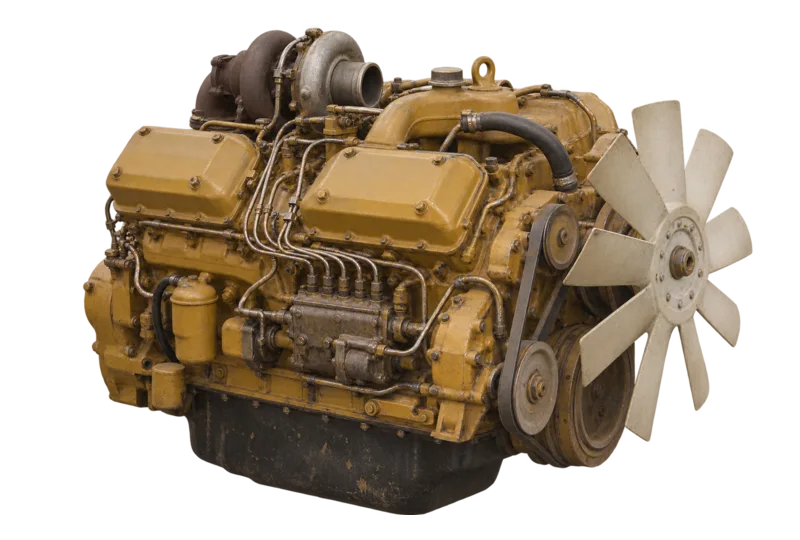
Key specifications
- Displacement
- 866 cu in (14.2 L)
- Configuration
- Four-stroke V8 diesel
- Fuel system
- Mechanical pump and individual injectors
- Typical factory output
- 322 hp at 2,400 rpm for the listed ENDT865 and 375 hp at 2,200 rpm for the listed ENDT866
- Peak torque
- 1,100 lb-ft at 1,350 rpm (ENDT865) or 1,040 lb-ft at 1,600 rpm (ENDT866) in the F-series brochure
- Aspiration
- Turbocharged. Mack describes a single turbocharger for the ENDT865.
- Engine brake
- Integral Dynatard design documented for the ENDT865
Where it was used
The displayed window is clipped to the catalog’s 1975 start. Mack’s engineering paper establishes the ENDT865 by 1971. CARB lists both suffix-C variants for 1975, the federal 1976 notice lists ENDT(B)-865, and the federal 1978 table documents Mack’s 866-cu-in V8 family alongside the 998-cu-in successor. The window describes documented U.S. model years and makes no claim about exact production cutoffs or identical availability for both calibrations.
- Mack lists the ENDT865 in its F795 and F895 cab-over chassis.
- The same period Mack brochure pairs the ENDT866 with the F797 cab-over.
- CARB’s earlier vehicle order groups the 865/866 family with R795/R797 conventional and DM895/DM897 vocational chassis.
Service life
300,000–400,000 milesHistorical heavy-duty rebuild benchmark
An early-1990s EPA study reported this range between rebuilds for heavy-heavy-duty diesels in its survey. The range describes the vehicles surveyed and is a point of comparison for this engine’s era.
For an overhaul, record the engine serial and pump numbers, establish the cylinder sealing and hot oil pressure, and survey block, head and crank condition. Earlier machine work and availability of the correct 866-cubic-inch parts can drive the scope.
Typical problems and service checks
A lazy pull after injection work
Get the pump and nozzle identification from the engine before checking a performance complaint after fuel-system work. Mack’s listed 865 and 866 torque peaks occur at different speeds, so the truck’s previous behavior and its verified calibration are useful evidence.
Smoke and low boost under load
Look for the load and engine speed at which smoke and weak pull occur together. Charge piping, intake restriction, a pre-turbo exhaust leak and pump delivery can produce overlapping symptoms. Mack’s ENDT865 engineering paper describes a single turbocharger for this design.
Dynatard responds unevenly
If an equipped ENDT865 responds intermittently to an engine-brake request, document which operating conditions reproduce it. A technician can check actuation and the engine’s valve and brake settings against the correct Mack instructions before making changes.
References
- Mack engineering paper: ENDT865 Maxidyne V8 and Dynatard
- California Air Resources Board: MY1975 Mack 866-cu-in turbocharged V8s
- Federal Register: 1976 model-year heavy-duty diesel engine certification data
- Federal Register: 1978 model-year heavy-duty diesel engines, p. 41550 (archival scan)
- California Air Resources Board: Mack F, R and DM chassis and original engine groupings
- Mack factory F-Series sales brochure: Maxidyne photo and engine options, pp. 9–10 (archival scan)
- U.S. EPA, Heavy-Duty Engine Rebuilding Practices