Mack ENDT Maxidyne inline-six
1975–1980
The early Maxidyne sixes helped shape how American Mack R-series tractors were geared and driven. Their broad power curve paired with Maxitorque transmissions for work over a wide engine-speed band. The 237-hp 675 and 285-hp 676 shared nominal displacement, but their charge cooling and calibrations differed. Decades of engine swaps make the block plate, pump tag and installed cooler layout more informative than the truck’s badge when buying parts or evaluating a take-out.
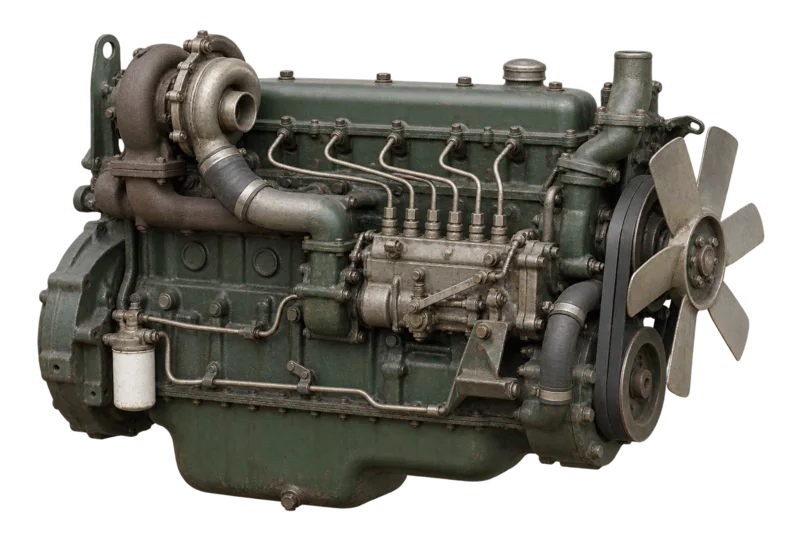
Key specifications
- Displacement
- 672 cu in (about 11.0 L)
- Configuration
- Turbocharged four-stroke inline-six; charge cooling varies by calibration
- Fuel system
- Mechanical direct injection with pump and lines
- Typical factory output
- 237 hp for the 675 and 285 hp for the 676 in documented Maxidyne designations
- Peak torque
- 1,080 lb-ft at 1,200 rpm on the documented 676-derived 285-hp calibration
- Bore × stroke
- 4.875 × 6.000 in for the documented 672-cu-in 676-derived design
- Aspiration
- Turbocharged; Mack’s 676-derived EM6-285 test engine diverts some compressor discharge air to power a tip-turbine cooling fan
- Compression ratio
- 17:1 for the documented 675 family; 15:1 on the EPA-test 676-derived EM6-285
Where it was used
Introduced before 1975. This entry shows the part of the early naming era inside the requested window. Mack’s certification cross-reference dates the adoption of EM6 designations to April 1980.
- Mack pairs the early Maxidyne and its Maxitorque transmission in the R-series highway tractor history.
- The 675 and 676 designations appear in Mack’s EPA-filed on-highway cross-reference to the later EM6-237 and EM6-285.
Service life
300,000–400,000 milesHistorical heavy-duty rebuild benchmark
An early-1990s EPA study reported this range between rebuilds for heavy-heavy-duty diesels in its survey. The range describes the vehicles surveyed and is a point of comparison for this engine’s era.
Use cold-start behavior, stabilized oil pressure, blow-by measured to an applicable procedure and the previous machine-work record. The engine tag and pump identification establish which overhaul parts can be specified.
Typical problems and service checks
Boost-side air path
On a 676 equipped with tip-turbine charge cooling, inspect the actual ducts, connections and cooling hardware before blaming the turbo for smoke under load. The early 675 and the 676 can have quite different intake hardware.
Mechanical pump and governor
Save the injection-pump identification and confirm the original rating if idle or road speed changed after pump service. The truck’s driveability depends on the interaction between this calibration, the gearing and the work it performs.
Evidence on a cold start
An old low-use truck can seem healthy once it is warm. Ask for a cold observation that captures cranking speed, time to clean running and smoke, then compare it with a warm restart and the maintenance record.