Mack E9 V8
1981–1998
The E9 was Mack’s large-displacement V8 for demanding diesel truck work. Mack originally offered distinct 400- and 440-hp versions with different torque characteristics. A later California certificate includes a 500-hp variant. Its two banks, mechanical fuel equipment and original air-cooling layout make parts identification particularly important on a restored or repowered truck. The engine serial and injection-pump model establish which specifications belong to the V8 installed in the truck.
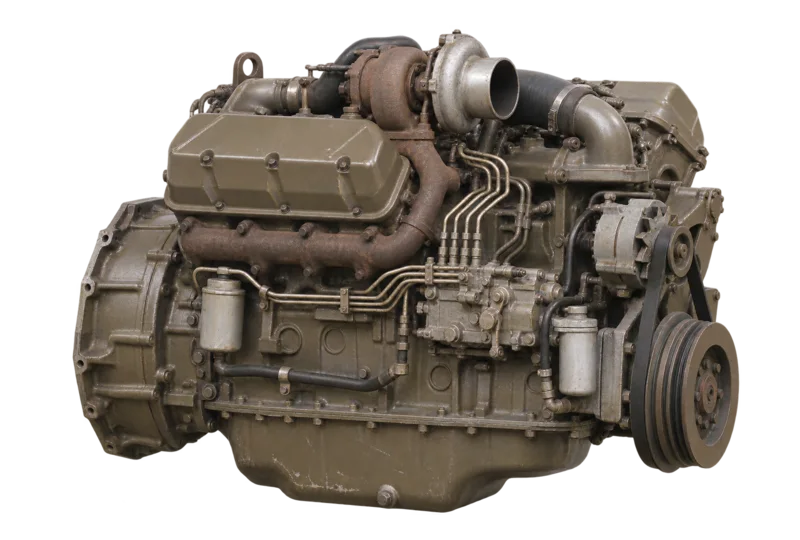
Key specifications
- Displacement
- 998 cu in (16.4 L)
- Configuration
- Four-stroke turbocharged V8 with chassis-mounted charge-air cooling on documented E9s
- Fuel system
- Mechanical direct injection; Bosch pump and injector hardware on certified 500-hp example
- Typical factory output
- 400 and 440 bhp at introduction; certified E9-500 at 500 bhp and 1,660 lb-ft
- Peak torque
- 1,660 lb-ft at 1,300 rpm on the CARB-certified E9-500
- Bore × stroke
- 5.375 × 5.500 in for Mack’s documented 998-cu-in V8
- Aspiration
- Turbocharged with chassis-mounted charge-air cooling in Mack’s E9 program
- Valvetrain
- Four valves per cylinder in the documented E9 design
- Rated engine speed
- 1,900 rpm on the certified 500-hp calibration
Where it was used
Approximate U.S. historical window. Mack’s 1981 filing includes its 998-cu-in V8 lineage, and its 1982 technical paper describes the E9 line. Later 500-hp on-road calibration is documented for 1990; 1998 is the approximate end of the highway era.
- Developed as a heavy-duty on-highway V8 in Mack’s documented 1982 E9 program.
- Verify the V8 serial and calibration on late Super-Liner or CL-era trucks identified as E9-powered. The chassis family alone cannot identify the engine.
Service life
1,000,000+ milesOne U.S. owner-operator’s original-engine mileage
At the 2011 Mid-America Trucking Show, Shell Rotella inducted Wisconsin owner-operator Jerry Kissinger and his 1991 Mack Superliner with its E9 V8. The owner and awards organizer were quoted in contemporaneous coverage, which placed the engine above one million miles and described original pistons, liners and rings as a condition of the award. The working tractor also received custom modifications. This establishes a reported lower bound for one engine, with no exact later first-overhaul mileage and no family-wide estimate.
Ask for machine-shop findings by bank, availability of matched fuel and valve-train parts, and the condition of the block, crankshaft and cooling hardware. A scarce part can determine the realistic rebuild schedule.
Typical problems and service checks
Find the source by bank
When one exhaust bank looks cooler or smokes differently, record which bank and at what speed and temperature. A qualified shop can use the applicable fuel and mechanical checks to separate an individual cylinder issue from a common air or fuel problem.
Identify the timing arrangement
For pump work, have the shop record the E9 model and actual injection equipment rather than transfer settings from another V8. Terms such as four hundred and five hundred identify ratings and leave the calibration and hardware questions open.
Inspect chassis charge cooling
Document the cooler type, available airflow and intake connections. Heavy-haul low-road-speed work can put different demands on the cooling system from unloaded running in the yard, so verification should account for the tractor’s operating conditions.
References
- Mack 1981 engine certification application, archived by EPA
- Mack engineers: E9 V8 technical paper
- CARB MY1990 500-hp E9 certification
- Heavy Duty Trucking: eyewitness account of the E9 and Shell award eligibility
- Overdrive: Shell Lubricants’ direct statement on the no-major-service threshold
- Overdrive: direct owner interview and identification of the exact E9 vehicle