Mack E7
1989–1997
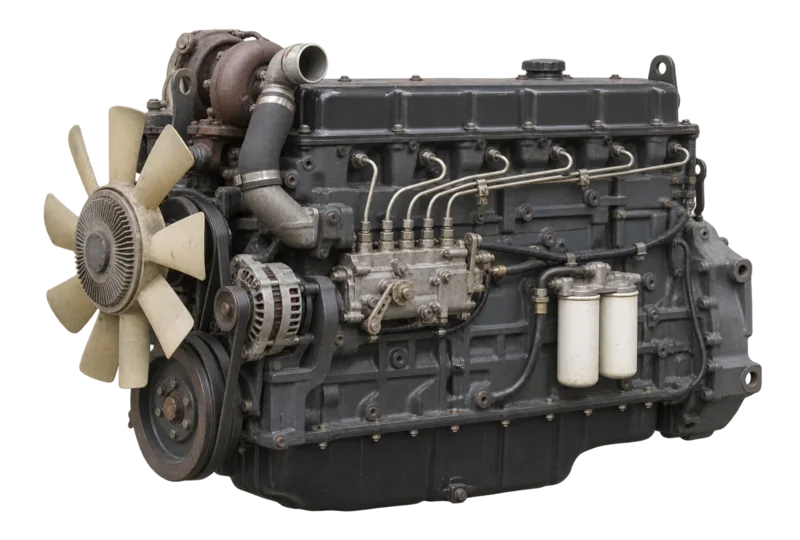
Mack developed the E7 to replace its previous generation of heavy-duty inline-six. Its first on-road versions covered a broad power range, and later early-1990s versions included Mack’s V-MAC controls and Econovance variable injection timing on applicable pumps. A truck can have a mechanical in-line injection system with electronic control features. Separate the block family, the fuel-metering hardware and the control package when reviewing a late E7 service history.
Key specifications
- Displacement
- 728 cu in (about 11.9 L; marketed as 12 L)
- Configuration
- Turbocharged, charge-air-cooled inline-six
- Fuel system
- Mechanical direct injection with in-line pump; electronic timing or controls on applicable V-MAC versions
- Typical factory output
- 250–400 hp at introduction; later ratings vary
- Peak torque
- 975 lb-ft at 1,200 rpm on MY1990 E7-250; 1,460 lb-ft at 1,250 rpm on MY1990 E7-400
- Aspiration
- Turbocharged with chassis-mounted air-to-air charge cooling in the original E7 engineering paper
- Rated engine speed
- 1,800 rpm on MY1990 E7-400; 1,950 rpm on certified E7-250 and E7-300 examples
- Injection equipment example
- Bosch pump and injectors on documented MY1990 E7 configurations; part numbers varied
Where it was used
Mack announced its E7 in 1989, with initial ratings calibrated to EPA 1990 standards. The interval covers the conventional pre-E-Tech family. The E7 designation also continued on later E-Tech engines.
- Mack’s original E7 was developed for heavy-duty on-road trucks and certified as a heavy-duty diesel in 1989.
- The CH-series highway era overlapped E7 production. The installed build and calibration determine the fit in any individual tractor.
Service life
500,000–600,000 milesHistorical heavy-duty rebuild benchmark
In a 1990s EPA study, more fleets expected at least 500,000 miles to first overhaul, and some heavy-duty diesels reached 600,000 between rebuilds. These are fleet benchmarks rather than a rating for this engine.
Mack publishes REMACK E7 basic-engine and overhaul options. A teardown estimate should include measured liner seating and crank journals, head condition and whether the identified pump and controls can be retained or rebuilt.
Typical problems and service checks
V-MAC timing control
If the engine uses Econovance, ask the technician to distinguish a timing control issue from a worn pump or another mechanical fault. Identify the exact fuel-system version before ordering the pump, actuator or control hardware.
Cross-reference parts by serial
Record the engine plate, piston or liner kit notes and injection-pump tag before opening the parts order. Some catalogs place several E7-era builds under one name even though the relevant part requirements differ.
Age of the cooling and air path
Inspect the actual front-mounted charge-air cooler and older hoses when load performance has changed. Capture both intake-side readings and the truck’s engine temperature history to help separate a boost loss from a fuel-related complaint.
References
- Mack engineers: original E7 technical paper
- CARB E7 on-highway certification example
- Mack history: E7, V-MAC and Econovance
- Mack REMACK basic engines and components
- Mack E7 overhaul documentation distinguishes PLN, E-Tech and ASET components
- CARB MY1990 Mack E7 ratings and injection equipment
- U.S. EPA, Industry Characterization: On-Road Heavy Duty Diesel Engine Rebuilders