Mack E6 / EM6
1980–1989
E6 and EM6 identify a family of mechanically injected Mack sixes built around an 11-liter block. Mack assigned EM6 labels to Maxidyne calibrations and used other E6 designations for different output and torque arrangements. The split matters when looking at old invoices: the same displacement appears with more than one cylinder-head, injection and charge-air setup. The useful starting point is the original engine model and serial plus the configuration found in the truck now.
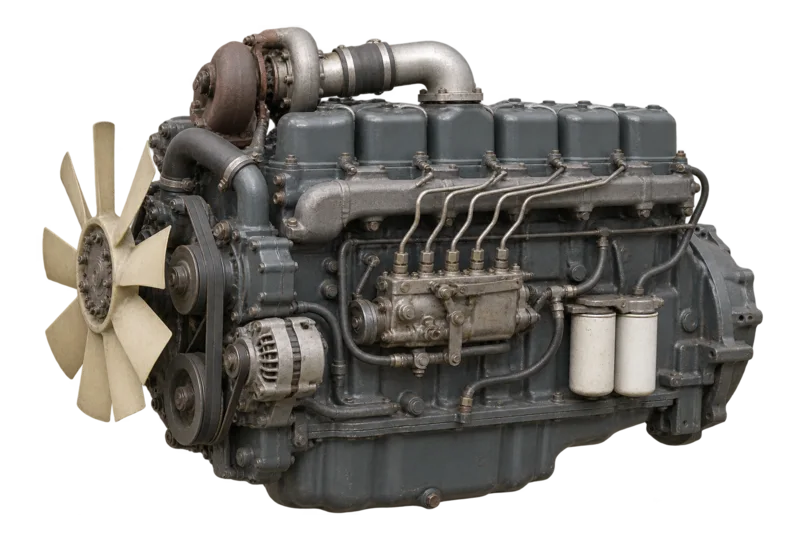
Key specifications
- Displacement
- 672 cu in (about 11.0 L)
- Configuration
- Turbocharged four-stroke inline-six; charge cooling varies
- Fuel system
- Mechanical direct injection; pump and governor details vary
- Typical factory output
- 200–350 hp across selected E6 and EM6 variants listed in the 1981 filing
- Peak torque
- 1,080 lb-ft at 1,200 rpm for the certified EM6-285 example
- Bore × stroke
- 4.875 × 6.000 in on the EPA-test EM6-285
- Aspiration
- Turbocharged; documented builds include tip-turbine and chassis-mounted charge-air cooling
- Compression ratio
- 15:1 on the EPA-test EM6-285; other family calibrations differ
- Rated engine speed
- 2,100 rpm on the 285-bhp EPA-test engine
Where it was used
Mack’s new terminology took effect in April 1980 for the covered models. The published interval follows the 1980s E6 era up to the E7 launch transition; it is approximate across ratings and chassis.
- The EM6-237 and EM6-285 continue documented early Maxidyne applications in Mack heavy on-road trucks.
- Mack’s certification identifies E6 and EM6 variants in the same heavy-duty engine family documentation. Match a surviving R-series installation to its engine plate and chassis record.
Service life
300,000–400,000 milesHistorical heavy-duty rebuild benchmark
An early-1990s EPA study reported this range between rebuilds for heavy-heavy-duty diesels in its survey. The range describes the vehicles surveyed and is a point of comparison for this engine’s era.
Mack’s REMACK program lists E6 basic engines. Verify availability by serial and build. For an in-frame candidate, the inspection must establish liner seating, the crankshaft’s condition and the history of any prior machining.
Typical problems and service checks
Different heads within the family
Confirm valve arrangement, head identification and mating parts before ordering a head. The E6 name covers configurations built for different ratings; existing cylinder-head and fuel-system parts are the key to the work order.
Tip-turbine cooling path
For a tip-turbine charge-cooled EM6, the EPA evaluation records a separate air path using part of the compressor boost. Check how the installed cooler, ducts and fan are arranged before interpreting intake temperature.
Fuel timing after major service
Start with the exact model and pump tag when a rebuilt engine starts differently, smokes or feels slow to pick up. The matched service information belongs with the pump, timing and governor work on the invoice.