Mack E-Tech / ASET
1998–2006
Late E7-lineage Mack engines combine a familiar 12-liter size with substantially different injection and emissions hardware. E-Tech builds use electronic fuel control with unit-pump hardware. ASET followed with application-specific emissions strategies, notably the cooled EGR highway engine and a distinct internal EGR vocational version. Identify the engine model, control generation and installed EGR hardware before using a parts catalog entry based on a truck’s model year or a bare E7 label.
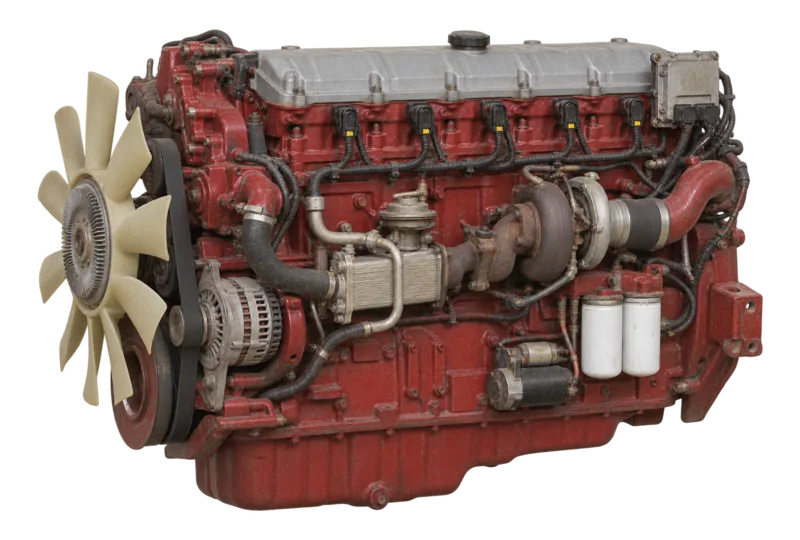
Key specifications
- Displacement
- 11.9 L, marketed as 12 L
- Configuration
- Turbocharged, charge-air-cooled inline-six
- Fuel system
- Electronically controlled unit pumps and separate injectors; application-specific calibration
- Typical factory output
- 1998 E7-branded ratings include 427 and 460 hp; ASET rating depends on AC or AI build
- Peak torque
- 1,560 lb-ft for the certified MY1998 E7-427 and 1,660 lb-ft for E7-460, both at 1,200 rpm
- Aspiration
- Turbocharged with charge cooling; highway ASET C-EGR and vocational ASET I-EGR have different air-management arrangements
- Rated engine speed
- 1,800 rpm for the documented MY1998 427- and 460-hp ratings
- Emissions hardware
- Cooled EGR on ASET Highway; internal EGR on ASET Vocational in Volvo Group’s 2002 launch records
Where it was used
Approximate E-Tech era starts with the 1998 engine lineup. Mack introduced ASET for the October 2002 emissions change, and 11.9-liter engines were still certified for 2006 as the MP lineup arrived.
- The E-Tech-era lineup included 12-liter Mack on-highway builds certified for 1998.
- ASET Highway C-EGR entered the U.S. market for the 2002 emissions transition. Mack’s Vision highway era and ASET production overlapped.
- ASET Vocational I-EGR was a different configuration and is included here for identification on related work trucks.
Service life
500,000–600,000 milesHistorical heavy-duty rebuild benchmark
In a 1990s EPA study, more fleets expected at least 500,000 miles to first overhaul, and some heavy-duty diesels reached 600,000 between rebuilds. These are fleet benchmarks rather than a rating for this engine.
Compare the actual block, injectors and pumps, head, wiring and EGR equipment with the serial-specific overhaul or replacement scope. Parts availability and the cause of the original failure are more useful than a generic E7 mileage estimate.
Typical problems and service checks
Unit pump circuit
A cylinder contribution result tells the shop where to investigate. Combine it with the unit-pump command, circuit condition and any mechanical findings before assigning an E-Tech or ASET power imbalance to the injector alone.
AC and AI air paths
Read the model plate and air-management diagram before pricing an EGR valve, cooler or manifold. Volvo Group’s 2002 explanation identifies different highway and vocational EGR approaches, so one test sequence cannot stand in for the other.
Controls after an engine swap
Confirm wiring, controls and emissions component compatibility after a replacement engine or electronic module has been installed. Keep the replacement serial and shop’s configuration record with the original fault report for future service.
References
- CARB MY1998 E7-427 and E7-460 data sheet
- Volvo Group 2002 report: highway and vocational ASET applications
- Mack official history: ASET and Vision
- CARB Mack 2006 11.9-liter certification
- Mack E7 overhaul documentation distinguishes PLN, E-Tech and ASET components
- U.S. EPA, Industry Characterization: On-Road Heavy Duty Diesel Engine Rebuilders