International V-800
1975–1979
International Harvester used its own large turbocharged diesel V8 in the Transtar II era. In a 1975 photograph, the manufacturer identified the V-800 as standard equipment in 16 road rigs from its U.S. bicentennial caravan. Federal certification documents give the 350 hp road engine 820 lb-ft of maximum torque. When one survives in a cabover today, its identification plate and engine history are valuable. IH used V-800 naming in other applications, and a decades-old truck may have had an engine or pump swapped.
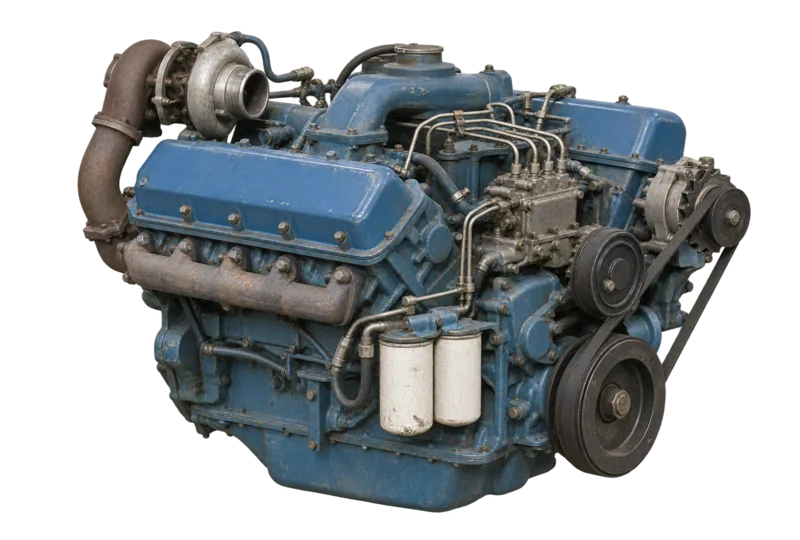
Key specifications
- Displacement
- 13.1 L (798 cu in)
- Configuration
- V8 diesel
- Fuel system
- Mechanical diesel injection
- Typical factory output
- 350 hp (U.S. federal certification)
- Peak torque
- 820 lb-ft (U.S. federal certification)
- Aspiration
- Turbocharged
- Cylinder bore
- 5.313 in (MAHLE engine-parts catalog)
Where it was used
1975–1979 is the dated diesel parts-catalog window within this guide. U.S. federal road-engine certification and International Harvester's Transtar II archival record directly establish period on-highway use. Factory literature existed by 1973.
- International Harvester's 1975 archive caption identifies a Transtar II used in the U.S. bicentennial caravan. It says its 16 display road rigs used the V-800 as standard power.
- EPA federal publications document the V-800 350-hp road-engine configuration in 1975, 1976 and 1977. The exact badge and engine plate are important on surviving tractors.
Service life
300,000–400,000 milesHistorical heavy-duty rebuild benchmark
An early-1990s EPA study reported this range between rebuilds for heavy-heavy-duty diesels in its survey. The range describes the vehicles surveyed and is a point of comparison for this engine’s era.
There is no verified first-overhaul mileage to quote. A condition assessment starts with the truck and engine history, calibrated hot oil pressure, crankcase pressure and cylinder evidence. Parts availability and the condition of the block and crankshaft matter when choosing a repair scope.
Typical problems and service checks
Long cranking when it has been parked
Document how long the truck sat, the temperature and whether the cranking speed sounded normal. Verify the supply circuit and shutoff linkage against the road-engine manual before taking the injection pump off a truck whose installed components may differ from the original build.
Smoke under load after years of low use
Note when the smoke appears, the load and the engine temperature. Start with intake restriction, air-path integrity and the service history of the injection system. A single smoke observation cannot identify which parts need work.
Low oil pressure when it is fully hot
Have a technician verify pressure with the correct test equipment and record the temperature and engine speed. If pressure is low, inspect lubrication history and the evidence of internal wear before deciding whether original components can be reused.
References
- International Harvester's 1975 Transtar II photograph and caption in the Wisconsin Historical Society collection
- Federal Register, 1975 model-year heavy-duty diesel certification data
- Federal Register, 1976 model-year heavy-duty diesel certification data, p. 10055
- Federal Register, June 8, 1977, V-800 350A submission
- University of Reading Museum of English Rural Life, International Harvester V-800 factory literature AD-5954-B and AD-5960-C
- MAHLE North American engine parts catalog, lines 117–119 on the 798-cu-in diesel
- U.S. EPA, Heavy-Duty Engine Rebuilding Practices