International MaxxForce 9 / 10
2008–2017
The MaxxForce 9 and 10 share Navistar's 9.3-liter inline-six platform and were sold with different ratings. Larger vocational WorkStar builds and certain TranStar tractors put the family into Class 8 service. Navistar later introduced SCR and the N9 and N10 service identifiers. The difference affects the emissions, controls and parts information used in the bay. A diagnostic record from one truck can still be helpful on another if it includes the actual engine and emissions identification rather than the door badge alone.
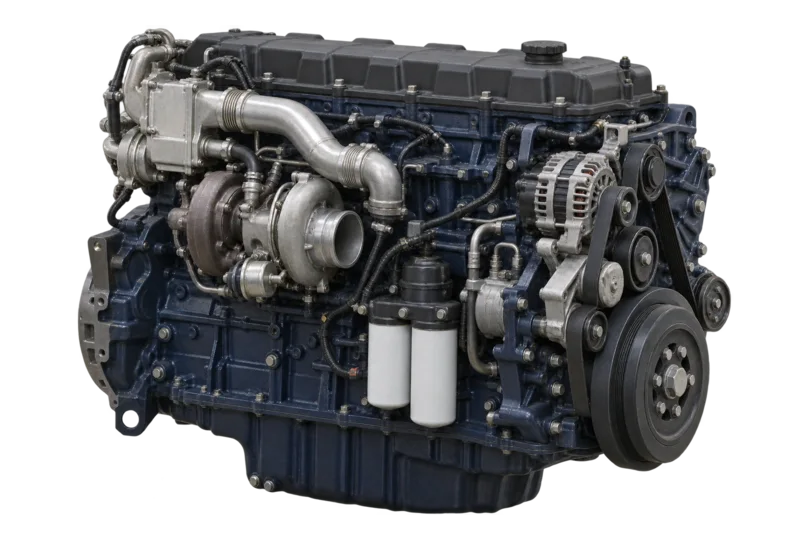
Key specifications
- Displacement
- 9.3 L (570 cu in)
- Configuration
- Inline six-cylinder turbocharged diesel
- Fuel system
- Electronically controlled hydraulic-actuated injection on documented MaxxForce 9/10 and N9/N10 applications
- Typical factory output
- 2008 MaxxForce 9: 300–330 hp and 800–950 lb-ft; MaxxForce 10: 310–350 hp and 1,050–1,150 lb-ft
- Peak torque
- 800–950 lb-ft (2008 MaxxForce 9) and 1,050–1,150 lb-ft (2008 MaxxForce 10)
- Bore × stroke
- 116.6 × 146 mm (2013 engines)
- Aspiration
- Two-stage turbocharging and charge-air cooling (2013 engines)
- Compression ratio
- 16.5:1 (2013 engines)
Where it was used
International's 2008 truck lineup identifies the MaxxForce 9 and 10 Class 8 applications. Navistar distinguishes EPA 2007–2013 MaxxForce labels from 2014–2017 N9/N10 emissions hardware in its workshop literature.
- International WorkStar Class 8 vocational builds with MaxxForce 9 or MaxxForce 10 as listed by Navistar.
- International TranStar Class 8 with MaxxForce 10 in the 2008 truck lineup.
- Later WorkStar vocational configurations with N9/N10 SCR, with rating and GVWR checked for each truck.
Service life
550,000 milesEPA 2010 MaxxForce 9/10 OEM B50
The International on-highway guide covering 2010-emissions engines publishes 550,000 miles B50 under its MaxxForce 9/10/DT heading. International separately documents Class 8 applications for both 9.3-liter models. No application-specific distribution appears in the maintenance guide.
Review working hours and oil and coolant usage over a consistent interval. Start with the prescribed injector-oil pressure and mechanical-condition checks so a controls fault does not inflate an overhaul estimate.
Typical problems and service checks
Intermittent injection control pressure under load
Preserve data from the original condition and use the applicable HPOP test. Navistar lists different diagnostic coverage by emissions year. Confirm which side of the high-pressure oil circuit the readings implicate before choosing a part.
Different emissions fault on an N9 or N10
Identify the SCR-equipped build and preserve the original fault chronology. The DEF circuit and the earlier EGR-focused emissions layout require different service paths. A prior repair on a similarly badged MaxxForce may be poor evidence for the new truck.
Higher oil use in PTO-heavy service
Count all engine hours, including body work and idle periods. Inspect the crankcase ventilation and leakage evidence before treating a shop-floor observation as proof of worn cylinders. Verify the pressure or oil-use trend with exact conditions recorded.
References
- International Truck MaxxForce lineup release with Class 7–8 MaxxForce 9 and Class 8 MaxxForce 10 applications
- International 2014 SCR transition for WorkStar and DuraStar
- International WorkStar factory specification card
- Navistar HPOP procedure with engine-family and model-year identification
- CARB table citing Navistar N9 displacement
- Navistar EPA 2013 MaxxForce DT/9/10 engine manual
- Ritchie Bros. original Texas auction catalog, lots 1808 and 1808A
- International Truck 2010-emissions MaxxForce 9/10/DT on-highway maintenance information guide, p. 12