International MaxxForce 13
2008–2013
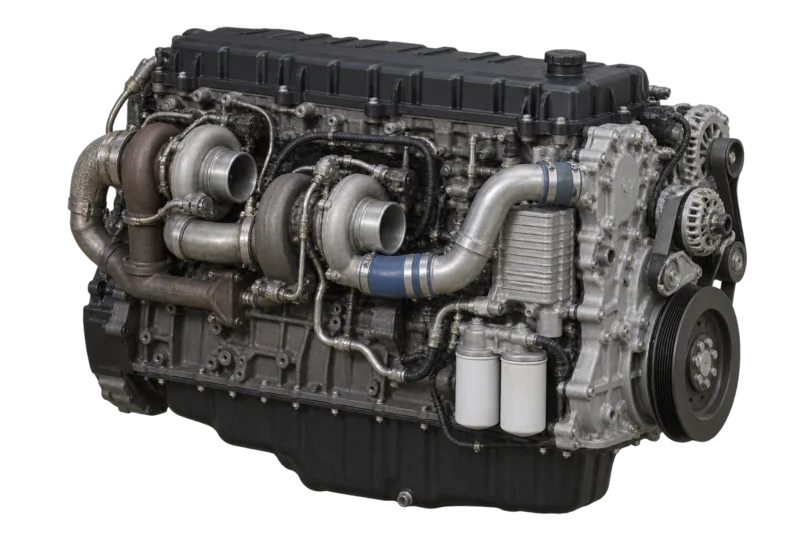
International put its 12.4-liter MaxxForce 13 into the ProStar line-haul tractor and other Class 8 applications. Navistar's published ratings and twin-series-turbo design reflect a big-bore engine with several chassis-specific installs. Many trucks in the field have had cooling, fuel or emissions work, so the service history matters as much as the original build. Verify the label and installed hardware near the 2013 transition, when the SCR-equipped N13 entered production alongside the outgoing non-SCR big-bore specifications.
Key specifications
- Displacement
- 12.4 L (13-liter class)
- Configuration
- Inline six-cylinder diesel with dual sequential turbocharging
- Fuel system
- Electronically controlled high-pressure common rail
- Typical factory output
- 410–475 hp and 1,450–1,700 lb-ft in Navistar's 2010 rating chart; later documented offerings extended to 500 hp
- Peak torque
- 1,450–1,700 lb-ft (published truck ratings)
- Bore × stroke
- 126 × 166 mm (2010 engine)
- Aspiration
- Dual turbochargers with interstage and charge-air cooling
- Compression ratio
- 17.0:1 (2010 engine)
- Dry weight
- 2,392 lb without accessories (2010 engine)
Where it was used
North American retail orders opened in January 2008. Navistar literature identifies non-SCR MaxxForce 11/13 builds through 2013 and distinguishes the SCR-equipped N13 offered from spring 2013.
- International ProStar Class 8 line-haul tractor.
- International TranStar and WorkStar applications in the big-bore release, depending on chassis and build.
- Navistar announced a 500-hp MaxxForce 13 option for International LoneStar in 2011; verify the serial and build on an individual truck.
Service life
Up to 1,200,000 milesOEM B50
Navistar published a B50 design figure of up to 1.2 million miles for MaxxForce 11 and 13 in its ProStar+ material. It is a population durability measure. Real condition and previous work matter when evaluating a given truck.
Navistar cited a 1.2 million-mile B50 design durability figure for the MaxxForce 11 and 13 in 2011. Check the current engine's hot pressures, oil consumption and evidence at teardown before approving overhaul scope.
Typical problems and service checks
Repeated cooling work with another low-coolant alarm
Record how the level is checked and whether earlier work addressed an external leak, cooler fault or another circuit. Use engine-specific tests to separate a repeat failure from a new source of coolant loss before authorizing head removal.
Rail pressure warning after a filter service
Confirm the installed filter and original trigger condition first. Use the appropriate measurements to separate inadequate supply from pressure control and delivery. The manufacturer publishes different coverage for 2010 engines and the 2013 HD-OBD version.
Hot oil pressure falls during a long idle
Use an appropriate gauge and the specified temperature so the comparison is meaningful. A VIN- and engine-matched inspection can determine whether the oil-pump bushing bulletin is relevant or whether the evidence calls for a different lubrication or internal repair.
References
- Navistar MaxxForce 11/13 North American retail launch and model coverage
- Navistar MaxxForce 11 and 13 power ratings
- Navistar ProStar+ and MaxxForce B50 specifications
- Navistar MaxxForce diagnostic model coverage
- Navistar MaxxForce and N13 oil pump bushing service bulletin
- Navistar 2010 MaxxForce 11 and 13 service manual