International MaxxForce 11
2008–2013
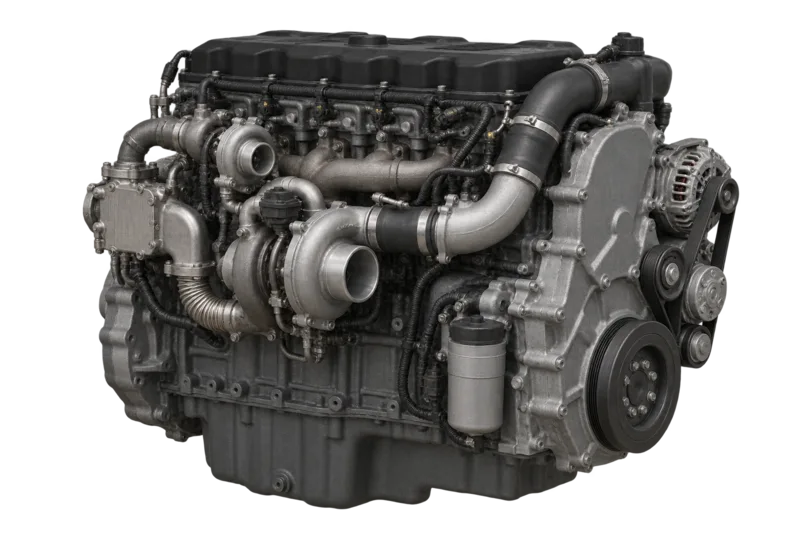
The 10.5-liter MaxxForce 11 was one of International's two MAN-collaboration big-bore diesels. It entered Class 8 service in regional and vocational applications, including TranStar and WorkStar. Turbocharger staging and the common-rail fuel system shape how a shop approaches a low-power complaint. Check the date and engine tag before using the procedure for a MaxxForce 13, even where the two look similar. The installed rating and emissions equipment can change the correct service parts and the test conditions.
Key specifications
- Displacement
- 10.5 L (11-liter class)
- Configuration
- Inline six-cylinder diesel, sequential turbochargers and interstage cooling
- Fuel system
- Electronically controlled high-pressure common rail
- Typical factory output
- 330–390 hp and 1,250–1,450 lb-ft in Navistar's 2010 rating chart
- Peak torque
- 1,250–1,450 lb-ft (published truck ratings)
- Bore × stroke
- 120 × 155 mm (2010 engine)
- Aspiration
- Dual turbochargers with interstage and charge-air cooling
- Compression ratio
- 16.5:1 (2010 engine)
- Dry weight
- 2,392 lb without accessories (2010 engine)
Where it was used
Navistar documented North American orders in January 2008. Its bulletin distinguishes 2010–2013 non-SCR MaxxForce 11 and 13 from the SCR-equipped N13 family.
- International TranStar Class 8 regional-haul tractor with the offered MaxxForce 11.
- International WorkStar Class 8 vocational models in the announced big-bore engine program.
Service life
Up to 1,200,000 milesOEM B50
Navistar published a B50 design figure of up to 1.2 million miles when describing the MaxxForce 11 and 13 for its ProStar+ heavy trucks. B50 is a population durability measure. The announcement provides no figures for a particular fleet's route or repair history.
Navistar published a 1.2 million-mile B50 durability figure for its MaxxForce 11 and 13 design in 2011. Assess the installed engine from oil pressure, crankcase measurement and the condition of its own serviceable surfaces.
Typical problems and service checks
Stage-dependent loss of boost
Record where the loss begins on the RPM and demand trace. Staged turbocharging and the interstage cooler create several places to look for leakage or a wrong pressure signal. Compare each stage under the model-specific diagnostic conditions.
Unstable hot oil pressure
Verify the oil and measured pressure at consistent temperatures. Navistar's service bulletin lists an oil-pump bushing inspection and repair route for applicable big-bore builds. A shop should follow the stated applicability and investigate the lower end if the measured evidence warrants it.
Power loss after work around the cooling system
Get the original service scope and determine which hoses or temperature inputs were touched. The launch engine's thermal management linked multiple cooler circuits. Identify the current build layout before ordering cooled EGR or charge-air components.
References
- Navistar Class 8 MaxxForce 11/13 retail launch and original ratings
- Navistar MaxxForce 11 and 13 power ratings
- International MaxxForce 11/13 technology and platform history
- Navistar ProStar+ and MaxxForce B50 specifications
- Navistar oil-pump bushing bulletin and 11/13 application dates
- Navistar 2010 MaxxForce 11 and 13 service manual