International DT570 / HT570
2004–2006
A snowplow and a road-maintenance dump truck show where the DT570 family earned its keep. A Colorado city purchased a 54,000-pound International 7400 with a 285-hp DT570. North Dakota recorded two 39,000-pound 7400 dump trucks with the 310-hp HT570. The 9.3-liter engine has an electrohydraulic injection system and a variable-geometry turbocharger, so diagnosing a warm restart, an under-load surge and an air-path problem means watching different data from what a later dual-turbo MaxxForce 9 or 10 would require.
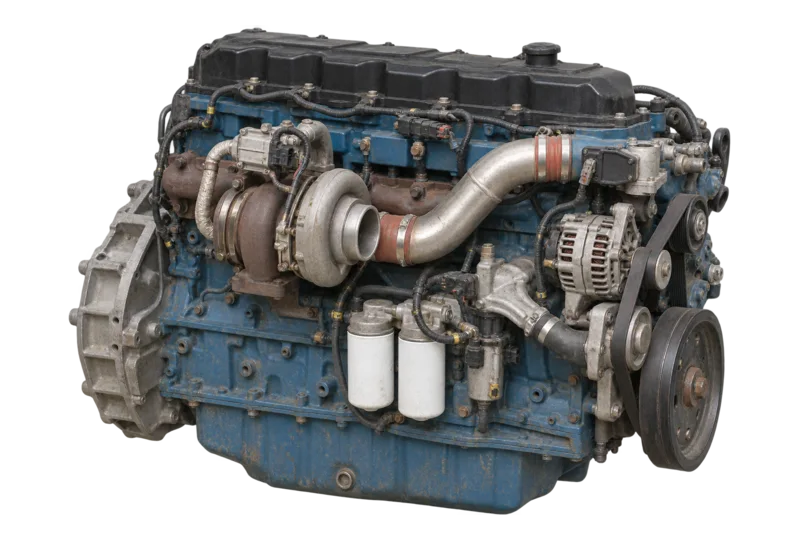
Key specifications
- Displacement
- 9.3 L (570 cu in)
- Configuration
- Inline-six diesel, four valves per cylinder
- Fuel system
- International second-generation electrohydraulic direct injection
- Typical factory output
- 285 hp (documented DT570) and 310 hp (documented HT570)
- Peak torque
- 800 lb-ft at 1,200 rpm (documented 285 hp DT570)
- Bore × stroke
- 116.6 × 146 mm
- Aspiration
- Variable-geometry turbocharger and charge-air cooling
- Compression ratio
- 17.5:1 (DT570 service specification)
Where it was used
This profile covers the 2004-emissions DT570/HT570 generation. Signed public records directly document 2005 and 2006 Class 8 International 7400 applications.
- Wheat Ridge, Colorado, specified a 2005 International 7400 6×4 at 54,000 lb GVWR with a 285 hp DT570 and 800 lb-ft for snow removal.
- North Dakota's 2023 fleet-auction record lists two 2006 International 7400 single-axle dumps with 310 hp HT570 engines and 39,000 lb GVWR.
Service life
500,000–600,000 milesHistorical heavy-duty rebuild benchmark
In a 1990s EPA study, more fleets expected at least 500,000 miles to first overhaul, and some heavy-duty diesels reached 600,000 between rebuilds. These are fleet benchmarks rather than a rating for this engine. North Dakota DOT recorded 212,181 miles in the comments field for 2006 7400 fleet unit 09815, a 39,000 lb GVWR single-axle dump with 310 hp HT570. The comments and current meter are separate fields. Previous engine work is absent from the auction record.
A plow or highway-maintenance truck can have many engine hours relative to its road miles. Check actual hot oil pressure, injection-control pressure and cylinder sealing as distinct measurements before committing to overhaul work.
Typical problems and service checks
Starts cold but cranks after a fuel stop
Document how long the truck sat after shutdown and whether it starts again once cool. Check cranking speed and compare commanded and measured injection-control pressure. Oil-side leakage can appear when hot oil thins, so the first useful pressure readings come from the failed start itself.
Surge during a steady plowing pass
Record engine speed, gear, load and any fault timestamps. The VGT and EGR systems interact with the air path, so a shop should check charge-air integrity and compare the relevant commanded and actual data at the same point in the complaint.
Coolant consumption between inspections
Track the loss from a consistent cold level and look for external stains. Pressure-test the cooling circuit and localize any internal leakage with the correct engine manual. A finding on the EGR cooler, for example, has a different repair scope from damage at the cylinder.