International DT530 / HT530
1999–2004
The DT530 put 8.7 liters in a relatively compact International inline-six. Oak Ridge National Laboratory studied one fitted to a manual-transmission PayStar 5000 utility bucket truck that weighed 43,780 pounds empty. The related HT530 appears in a 56,000-pound International 7500 equipped with six-wheel drive. Even in the same platform, a utility truck, refuse body and highway-service dump can accumulate hours at very different rates. Use the serial number and data plate to establish the engine build before ordering parts or comparing pressure readings.
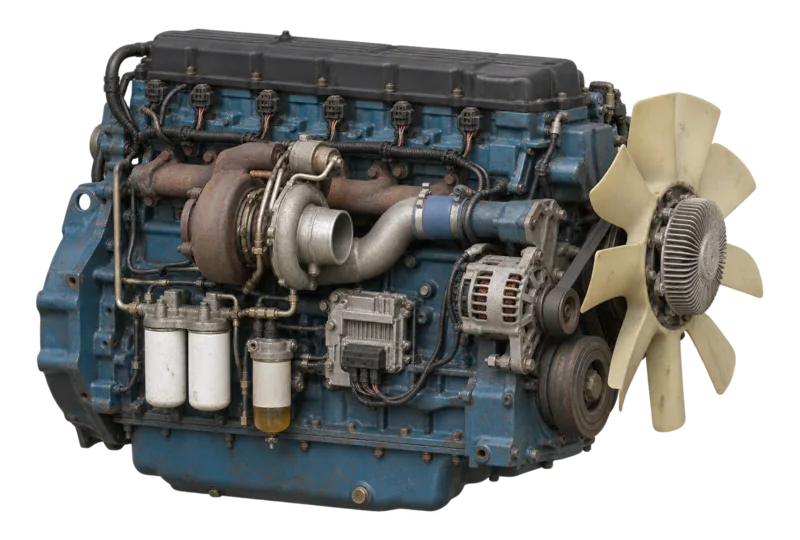
Key specifications
- Displacement
- 8.7 L (530 cu in)
- Configuration
- Inline-six, four-stroke diesel
- Fuel system
- Electronically controlled direct diesel injection (2001 CARB certification)
- Typical factory output
- 275 hp at 2,000 rpm (2001 certified DT530); 300 hp (documented HT530 7500)
- Peak torque
- 800 lb-ft at 1,200 rpm (2001 CARB model CG275)
- Bore × stroke
- 4.59 × 5.35 in (International DT530 power-unit brochure)
- Aspiration
- Turbocharged and charge-air cooled
Where it was used
1999–2004 is the directly documented Class 8 chassis window. A 1999 International 4900 DT530 and a 2004 International 7500 HT530 anchor the endpoints.
- Oak Ridge National Laboratory logged a Class 8 PayStar 5000 utility bucket truck with a DT530 8.7 L and a recorded 43,780 lb empty weight.
- A 1999 International 4900 4,500-gallon fuel truck used the DT530 with dual PTOs and a 54,000 lb GVWR.
- Custom Truck One Source recorded a 300 hp HT530 in a 2004 International 7500 6×6 day cab at 56,000 lb GVWR.
Service life
500,000–600,000 milesHistorical heavy-duty rebuild benchmark
In a 1990s EPA study, more fleets expected at least 500,000 miles to first overhaul, and some heavy-duty diesels reached 600,000 between rebuilds. These are fleet benchmarks rather than a rating for this engine. Custom Truck One Source's inventory sheet for a 56,000 lb GVWR 2004 International 7500 6×6 with a 300 hp HT530 records 90,799 ECM miles, 90,803 dash miles and 6,510 hours. Those are readings from one truck. The record gives no overhaul interval.
On a high-hour utility truck, compare warm oil pressure and measured crankcase pressure with the service limits for its engine serial number. Coolant findings and piston, liner and bearing condition guide the overhaul decision.
Typical problems and service checks
A miss that only appears at work speed
Note whether the truck surges at a fixed PTO setting or under road load. The shop should confirm the control inputs, carry out the appropriate cylinder contribution checks and verify fuel delivery at the condition that triggers the miss.
Oil pressure warning after the truck warms up
Record oil temperature, RPM and whether the warning first appeared during road or PTO work. Verify actual oil pressure against the correct engine specification. A true hot pressure loss changes how urgently the truck needs to be inspected.
Coolant loss on a truck that does little highway work
Cold coolant-level records and visible leaks help decide how to proceed. A shop can pressure-test the cooling system and look for cross-contamination before inspecting inside the engine. Track hours because repeated short drives can make a mileage-only log misleading.
References
- US Department of Energy and Oak Ridge National Laboratory, Table 3
- California Air Resources Board 2001 International DT530 Executive Order
- International factory DT530 power-unit brochure
- Ritchie Bros. original 1999 International 4900 DT530 fuel truck inspection
- Custom Truck One Source original 2004 International 7500 HT530 inventory sheet
- Selking International dealer's 2004 7500 HT530 Class 8 listing
- U.S. EPA, Industry Characterization: On-Road Heavy Duty Diesel Engine Rebuilders
