Detroit Diesel Series 92
1975–1995
The Series 92 brings larger cylinders to Detroit’s classic two-stroke layout. Its 8V92TA is an especially recognizable automotive V8, with a turbocharger, aftercooling and a blower for scavenging. An older tractor can carry mechanical injection or a later electronic-control version, which changes the parts and diagnostic route. Before pricing a repair, establish the actual engine model and what the truck builder put around it, especially the cooling package and controls.
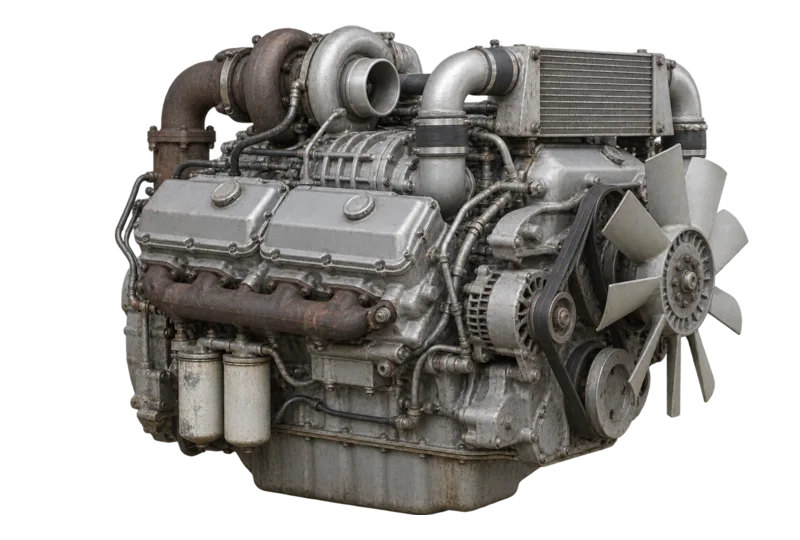
Key specifications
- Displacement
- About 9.0 L for 6V92 and 12.1 L for 8V92. Other layouts served other markets.
- Configuration
- Two-stroke, blower-scavenged V6 or V8 in the highway configurations covered here.
- Fuel system
- Mechanical unit injectors and later DDEC electronic unit-injector versions, depending on build.
- Typical factory output
- The 1979 federal tables list automotive 8V92TA ratings around 430–435 hp in particular certifications. Other applications and model years had their own ratings.
- Peak torque
- 1,242 lb-ft at 1,400 rpm in Detroit’s published 8V92TA/TTA automotive example. The 1979 federal record lists examples of 1,230 and 1,292 lb-ft.
- Bore × stroke
- 4.84 × 5.00 in, nominal for Series 92.
- Aspiration
- Blower scavenging with turbocharging and aftercooling on 8V92TA/TTA automotive configurations.
- Family displacement unit
- Nominal 92 cu in per cylinder.
Where it was used
Approximate U.S. highway coverage. The family predates the 1975 cutoff. The 1976 Peterbilt approval, 1979 federal tables and Detroit’s 1990 CARB certification provide firm highway anchors. DDEC highway versions continued into the 1990s, and the upper boundary represents the transition era.
- CARB’s 1976 Peterbilt heavy-duty vehicle approval includes the 8V-92TA. That places the automotive V8 in a period U.S. truck lineup before the examples in the 1979 federal engine tables.
- Use a chassis build record and engine tag to confirm the configuration. Detroit supplied two-strokes to several markets and each installation had its own cooling and rated output.
Service life
500,000–600,000 milesHistorical heavy-duty rebuild benchmark
In a 1990s EPA study, more fleets expected at least 500,000 miles to first overhaul, and some heavy-duty diesels reached 600,000 between rebuilds. These are fleet benchmarks rather than a rating for this engine.
Use an oil-consumption baseline and the exact Detroit two-cycle operator and overhaul documentation. An older take-out may have worked in a different application, so its build and condition should be checked as a separate question from whether it fits.
Typical problems and service checks
Cooling and aftercooling
Persistent temperature rise under load deserves an inspection of the installed radiator package, airflow and the engine-specific cooling and aftercooling system. Compare the complaint at the reported speed and load whenever safe operating conditions permit.
Liner and coolant condition
Ask which coolant is in use and how the lab or shop evaluated its condition. A coolant-loss complaint calls for repeatable cold-level tracking and the correct test procedure before any internal repair is estimated.
DDEC or mechanical controls
Check the engine tag and controller or governor arrangement before interpreting a rough-run report. The technician can then choose the appropriate data retrieval or mechanical test and include the exact configuration on the work order.
References
- Detroit Diesel 8V92TA/TTA original automotive brochure, archive scan
- Federal Register highway diesel ratings, 1979 model year
- EPA heavy-duty diesel emissions study with Detroit engine ratings
- CARB 1990 certification, 11.1 L Detroit and 9.0 L V92 family
- Detroit Diesel operator guide for Series 53, 71 and 92, OEM archival copy
- CARB 1976 Peterbilt highway vehicle approval, model and engine list
- Detroit Diesel Series 92 original service manual, general specifications, archive scan
- U.S. EPA, Industry Characterization: On-Road Heavy Duty Diesel Engine Rebuilders