Detroit Diesel Series 71
1975–1985
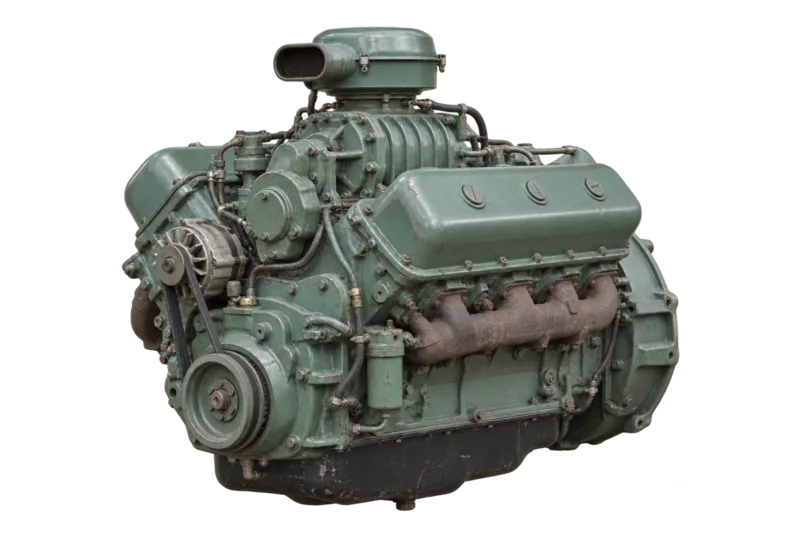
Series 71 engines brought a very different daily rhythm to a highway tractor than a modern diesel. The two-cycle design uses a blower to move fresh air through the cylinders, even on an engine described as naturally aspirated. The 8V71 had multiple automotive configurations, so the suffix matters every time somebody shops for fuel, air or cooling hardware. On a preserved tractor, identifying which configuration is still installed is part of the repair.
Key specifications
- Displacement
- 71 cu in per cylinder, nominal. The 8V71 is about 9.3 L.
- Configuration
- Two-stroke diesel family with inline and V layouts. The 8V71 is a V8.
- Fuel system
- Cam-operated mechanical unit injectors on period automotive versions.
- Typical factory output
- Engine and suffix dependent. The naturally aspirated truck 8V71 is commonly represented by the 318 hp rating.
- Peak torque
- 818 lb-ft at 1,400 rpm on the Detroit 8V71N 318 hp truck example.
- Bore × stroke
- 4.25 × 5.00 in in the 8V71 automotive family.
- Aspiration
- Blower scavenging on naturally aspirated and turbocharged models. Period automotive configurations include 8V71N and 8V71TA.
- Governor
- Mechanical governor on the cited 8V71 automotive configurations.
- Family displacement unit
- Nominal 71 cu in per cylinder.
- Compression ratio
- 18.7:1 on the 8V71N truck example with 7E65 injectors.
Where it was used
Approximate late highway era for this directory, clipped at 1975. Detroit dates the family’s debut to 1938 and dates broader heavy-truck availability to after the Series 53’s introduction. The mid-1980s endpoint is an approximate transition marker, and the wider Series 71 history extends beyond it.
- CARB’s 1976 Peterbilt heavy-duty vehicle approval lists Detroit 6L-71N, 8V-71N and 8V-71TA applications. It is a period example of series-level options in a U.S. truck line.
- Detroit’s automotive sheets identify naturally aspirated and turbocharged 8V71 variants. Compare the data plate with the truck’s build record after decades of possible repowers.
Service life
300,000–400,000 milesHistorical heavy-duty rebuild benchmark
An early-1990s EPA study reported this range between rebuilds for heavy-heavy-duty diesels in its survey. The range describes the vehicles surveyed and is a point of comparison for this engine’s era.
Keep the engine tag, smoke and oil-use history, past overhaul paperwork and observations from tests under the applicable Detroit procedures. Prior maintenance and the installed engine’s condition establish a sounder starting point than its odometer reading alone.
Typical problems and service checks
Airflow through the blower
Watch for a change in smoke or response after air-intake or blower work. Because the blower supports scavenging even on naturally aspirated versions, the shop should identify both the air path and the exact hardware before ordering parts.
Tune-up identification
Record the injector type, exact model and governor when gathering the service history. A tune-up from another Series 71 configuration may have used different settings. The technician needs the procedure that matches the installed components.
Oil specification and smoke
Identify the actual oil used and ask which Detroit two-cycle guidance covers the engine. When oil consumption rises, track additions and the conditions that bring on smoke. Clear usage records help separate leaks and internal causes.
References
- Detroit Diesel history and milestones
- Detroit history of two-cycle and highway engines
- Detroit Diesel 8V71NA original automotive brochure, archive scan
- Detroit Diesel 8V71TA/TTA original automotive brochure, archive scan
- Detroit Diesel operator guide for Series 53, 71 and 92, OEM archival copy
- Federal Register 1979 model-year heavy-duty diesel engines
- CARB 1976 Peterbilt engine application approval
- U.S. EPA, Heavy-Duty Engine Rebuilding Practices