Detroit Diesel Series 60
1987–2010
The Series 60 made electronic control familiar to fleets that had grown up with Detroit two-strokes. The inline-six went through several displacements and DDEC generations across its long highway run. A truck that has been repowered may carry a build from a different year than its cab. Its data plate and emission certification will lead to the proper manuals for fuel and air equipment, crankcase service, and the exhaust hardware installed on that particular engine.
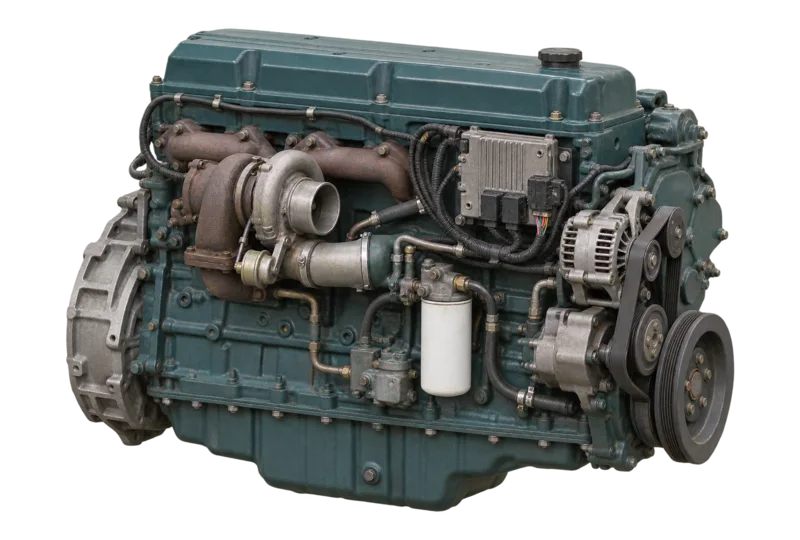
Key specifications
- Displacement
- 11.1 L, 12.7 L and 14.0 L across U.S. highway builds.
- Configuration
- Four-stroke, turbocharged, charge-air-cooled inline six.
- Fuel system
- Electronically controlled unit injectors under generation-specific DDEC controls.
- Typical factory output
- Rating depends on displacement and build. The 1990 CARB 11.1 L example lists selected 285–350 hp ratings.
- Peak torque
- For the selected 1990 11.1 L highway configurations, CARB lists up to 1,250 lb-ft at 1,200 rpm. Later arrangements vary.
- Bore × stroke
- 130 × 139 mm for 11.1 L, 130 × 160 mm for 12.7 L, and 133 × 168 mm for 14.0 L.
- Aspiration
- Turbocharged with charge-air cooling. Turbo hardware varies by generation.
- Firing order
- 1-5-3-6-2-4 in the Detroit service specifications.
Where it was used
Detroit dates the introduction to 1987. Its EPA07 manual documents the last major U.S. highway emissions generation before the DD platform transition around 2010. The endpoint is approximate for highway installations. Later service work and non-road production are separate.
- Freightliner FLD, Century Class and some Columbia configurations are accessible starting points in the OEM driver literature. A Detroit Series 60 identification should be confirmed against the chassis and installed engine records.
- For an EPA07 assembly, the exhaust-system service record should follow the actual engine and aftertreatment. Older trucks can have a mixture of original and replacement hardware.
Service life
1,000,000 milesHistorical field demonstration
Chevron’s corporate Delo history lists the Detroit Diesel Series 60 by model in its 1996 million-mile-to-overhaul demonstration. The same publication describes a separate R.E. West Transportation Series 60 torn down for inspection at 1.5 million miles. These are reported performance examples, not a fleet-wide estimate or a Detroit service interval. A separate PuraDYN report described several Class 8 Series 60 trucks passing 1.5 million miles without an overhaul on a bypass-filtration program, but did not identify the carrier.
Judge an individual engine through the rebuild record, oil usage, crankcase and coolant information, mechanical checks and any DDEC event reports. Set a service baseline from the correct year and duty cycle.
Typical problems and service checks
DDEC event and supply data
Record when the dash lamp, cruise change or torque loss appeared, then save the relevant active and stored data before clearing faults. On EPA07 DDEC VI, identify which controller saw the event and document any related electrical checks.
Coolant chemistry
Keep makeup coolant and filter entries together. Detroit guidance covers different coolant types and describes additive maintenance on applicable builds. When the product history is unclear, ask the shop to identify what is in the system and establish a new baseline.
EPA07 filter service
A parked regeneration and filter cleaning belong on separate lines. Match the dash behavior and service report to the installed filter and Detroit’s EPA07 instructions. Later warning patterns are easier to interpret with that history.
References
- Detroit Series 60 OEM legacy overview
- Detroit Diesel history and milestones
- Detroit Series 60 EPA04 operator guide
- Detroit Series 60 EPA07 operator guide
- CARB 1990 Detroit highway certification including 11.1 L engine ratings
- Freightliner FLD conventional driver manual
- Freightliner Century Class ST and Coronado driver manual
- Freightliner Columbia driver manual
- Detroit Series 60 service-manual specification table, OEM archive copy
- Chevron/Caltex Delo history, model-specific demonstration and R.E. West field inspection
- PuraDYN supplier statement as carried by Commercial Carrier Journal