Detroit Diesel DD8
2018–2024
The 7.7-liter DD8 was launched chiefly as a medium-duty engine, yet the engine also appears in a documented Class 8 Freightliner M2 truck-tractor. That distinction matters when looking up tires, drivetrain ratings or duty-based engine service. The same engine name appears in municipal trucks, fire equipment and lighter M2 builds. Establish the vehicle’s GVWR and actual engine rating before treating a specification or maintenance interval as belonging to its use as a tractor.
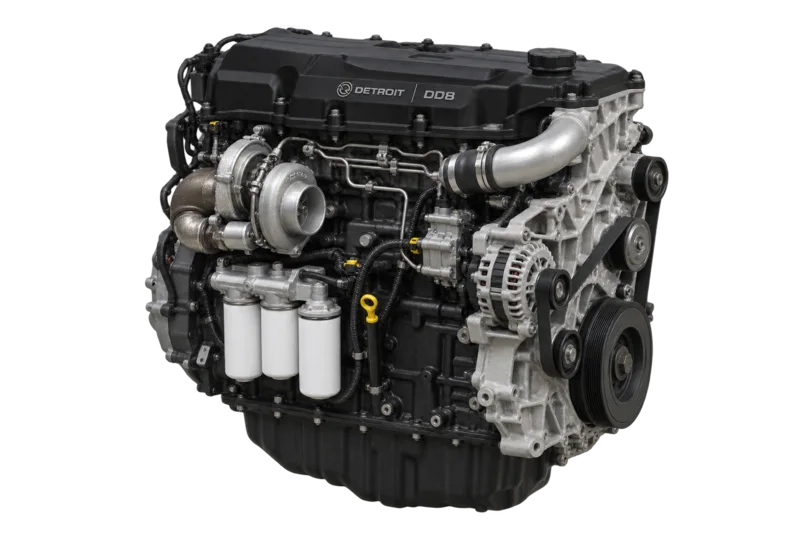
Key specifications
- Displacement
- 7.7 L.
- Configuration
- Four-stroke inline six.
- Fuel system
- Electronic common-rail direct diesel injection.
- Typical factory output
- 260–350 hp for the published regular truck range. Detroit reserves the 375 hp rating for named fire/emergency and RV applications.
- Peak torque
- 660–1,050 lb-ft across the Detroit DD8 brochure rating table.
- Bore × stroke
- 110 × 135 mm.
- Aspiration
- Turbocharged and charge-air-cooled.
- Compression ratio
- 17.6:1 in Detroit’s published DD8 specification.
- Oil service fill
- 26.9 U.S. qt (25.5 L), including filter, in the cited product sheet.
Where it was used
Daimler announced North American DD8 production in February 2018. A NHTSA record identifies a Class 8 M2 tractor in 2019. NHTSA also records DD8 Class 8 M2 chassis in model-year 2024. The endpoint is the latest verified heavy-class example used in this profile, rather than the last production date for the DD8.
- The federal vPIC decoder identifies a 2019 Freightliner M2, a Truck-Tractor body and Class 8 GVWR, with the Detroit Diesel DD8 7.7 L engine. This verifies a specific pairing, independent of the broader published M2 option lists.
- The same decoder also identifies Class 8 M2 incomplete truck chassis in model-year 2024 with DD8. Confirm chassis weight class and body type by VIN on another truck.
Service life
400,000 milesOEM B10
Detroit’s original DD8 product sheet gives B10, a design mileage at which a specified ten-percent share may require major overhaul or fail under the rated conditions. It is a different measure from B50.
Detroit’s DD8 brochure gives a 400,000-mile B10 design figure. Establish engine-specific service intervals from the applicable model and duty chart, then compare oil and coolant trends and any earlier major repair to the current operating conditions.
Typical problems and service checks
Identify the installed rating
Detroit lists several output and torque combinations and separates certain emergency or RV ratings. Keep the serial and actual rating with the truck record. That helps the shop select the match for a fueling or driveline check.
Oil complaints need proper context
Verify the actual pressure warning, engine state and oil service history. Detroit issued guidance on normal oil conditions for the DD5 and DD8 family. A laboratory sample or a complete pressure check gives the adviser context for maintenance decisions.
Aftertreatment at regional duty
Frequent idle and shorter trips affect how the truck accumulates hours and exhaust restriction. Bring the exact lamp and fault history, then check which duty chart and emissions equipment apply before setting the next service.
References
- Daimler Truck North America DD8 introduction
- Detroit DD8 OEM specifications and B10 durability figure
- NHTSA VIN decode, 2019 Freightliner M2 Class 8 truck-tractor, Detroit DD8
- NHTSA VIN decode, 2024 Freightliner M2 Class 8 incomplete truck, DD8
- Detroit DD5 and DD8 oil service bulletin filed with NHTSA