Detroit Diesel DD16
2010–2026
The DD16 takes the Detroit heavy-duty platform into severe service where a tractor may spend long periods pulling hard at modest road speed. The engine can look completely settled in a yard while a cooling or retarding complaint only appears on the job. A heavily specified Western Star is a useful example of why the chassis and trailer matter. Build the service request around the real load, gear, temperature, grade and engine behavior.
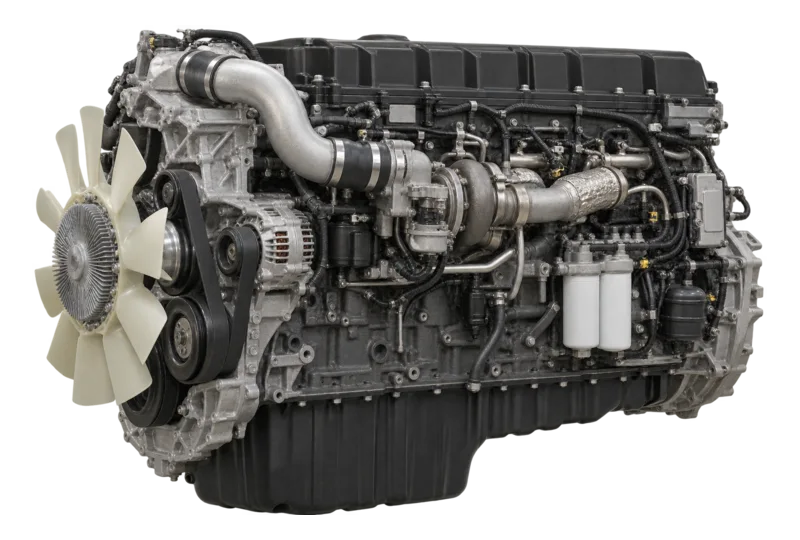
Key specifications
- Displacement
- 15.6 L.
- Configuration
- Four-stroke, turbocharged inline six.
- Fuel system
- Electronically controlled, high-pressure common-rail direct injection.
- Typical factory output
- Western Star lists 560–605 hp and 1,850–2,050 lb-ft for its DD16 offering. Read the installed build for the actual rating.
- Peak torque
- 1,850–2,050 lb-ft in the cited Western Star offerings.
- Bore × stroke
- Approx. 139 × 171 mm for EPA10/GHG14, using Detroit’s published stroke and stroke-to-bore ratio.
- Aspiration
- Turbocharged with charge-air cooling.
- Valvetrain
- Dual overhead cams, four valves per cylinder in the EPA10/GHG14 specifications.
- Compression ratio
- 17.1:1 in Detroit’s cited EPA10/GHG14 specification.
Where it was used
Approximate first U.S. highway model-year era following the introduction of DD15 and DD13. Detroit identifies the DD16 as the severe-duty member of the original heavy-duty platform. The series remains in the 2026 window. The announced 2027 generation is outside coverage.
- Western Star’s 49X is a current North American heavy-haul tractor example and its powertrain guide lists DD16 specifications. Confirm the engine option and duty package on the chassis build.
- Detroit also documents DD16 within the broader Freightliner and Western Star platform history. Model, year and application determine availability.
Service life
1,200,000 milesOEM B50 for GHG17 DD16
Detroit’s GHG17 North American DD16 brochure states a 1.2-million-mile B50 design life. This is the manufacturer’s median design benchmark for the documented generation, not an instruction to defer repairs or an observation that every current generation reaches that mileage.
Engine hours, payload, long-idle exposure, oil and coolant trends, and prior major work are valuable evidence. Have the shop verify the repair against the complaint where it can be reproduced safely.
Typical problems and service checks
Low-speed cooling capacity
Record the complaint’s gross weight, speed, grade and ambient conditions. Ask for the fan response and cooling-package inspection results. A comparison with a safe light-duty run can show why the engine needed a load-specific evaluation.
Engine-brake performance
Tell the shop which gear and retarder setting were selected, then have the control and mechanical response checked under the correct procedure. Where safe operation is in doubt, arrange inspection without repeating the event on a downgrade.
Lubrication and contamination
If a stop warning or abnormal oil result came before internal work, give the shop the original reading and oil-sample history. Have it identify the condition of the affected circuits and any transferred component before the engine is returned to service.
References
- Detroit history of the DD heavy-duty platform and generational update
- Detroit DD platform general specifications filed with NHTSA
- Detroit heavy-duty DD platform operator manual
- Detroit bulletin on poor DD platform engine-brake performance
- Western Star Detroit engine rating and option guide
- Western Star 49X tractor and heavy-haul product information
- Detroit DD16 GHG17 engineering brochure, durability overview