Detroit Diesel DD15
2008–2026
The DD15 anchors the highway end of Detroit’s heavy-duty platform. It remained a 14.8-liter inline six through several major generations, so the service information still depends on the engine’s actual family and year. A later Gen 5 truck and an early DD15 can need different parts and tests. For a fleet with more than one build, record the platform generation beside the engine serial, lubricant approval, filter and aftertreatment history.
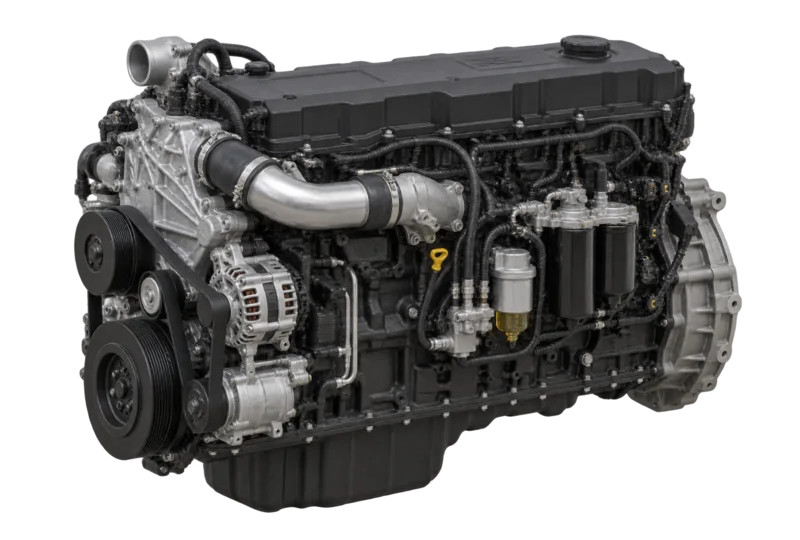
Key specifications
- Displacement
- 14.8 L.
- Configuration
- Four-stroke, turbocharged inline six. Turbo hardware depends on generation and rating.
- Fuel system
- Electronically controlled direct injection through a high-pressure common rail.
- Typical factory output
- Selected Western Star profiles show 425–505 hp and 1,650–1,900 lb-ft. Earlier generations and build options differ.
- Peak torque
- 1,650–1,900 lb-ft in selected Western Star configurations.
- Bore × stroke
- Approx. 139 × 163 mm for EPA10/GHG14, using Detroit’s published stroke and stroke-to-bore ratio.
- Aspiration
- Turbocharged with charge-air cooling. Earlier and current hardware vary by specification.
- Valvetrain
- Dual overhead cams, four valves per cylinder in the EPA10/GHG14 specifications.
- Compression ratio
- 18.0:1 in Detroit’s cited EPA10/GHG14 specification.
Where it was used
Detroit describes the DD15 launch in 2007 and use of the platform beginning in the 2008 era. Coverage begins at the approximate first U.S. highway model years. Gen 5 belongs within this directory, and the 2027 Gen 6 announcement is outside the window.
- Freightliner’s historic timeline calls out the DD15, DT12 and axle combination on Cascadia Evolution. Later Cascadia literature continues to document the DD15, and Western Star lists its own configurations.
- An engine serial and current chassis specification are the best parts-order pair for a tractor that has already had powertrain work.
Service life
1,200,000 milesPublished B50
CARB Table II-4 reports this 14.8 L Class 8 DD rating, citing Fletcher and Lyden’s 2009 engine guide. It is a B50 figure for the referenced generation, separate from a warranty or an individual truck’s overhaul interval.
Start with hours, mileage, duty, oil use and the service report for the exact engine. OEM verification procedures are the right basis for a current health decision and for judging a rebuild.
Typical problems and service checks
Oil pressure and verification
A pressure warning calls for the manufacturer’s response. Preserve the operating temperature and load from the first event. Have the shop identify the applicable oil module, sensor circuit and verification procedure for that generation.
High-pressure fuel complaint
Ask which part of the fuel system was tested, at what engine condition and under which procedure. The technician should establish the relevant supply and control evidence before quoting fuel hardware. High-pressure work belongs to qualified personnel.
Protection and aftertreatment history
Save a snapshot of the fault, engine state and warnings before clearing codes. Early and later DD15 trucks differ in their equipment and control logic. A mechanically sound engine can still be restricted by a warning or protection condition.
References
- Detroit history of the DD heavy-duty platform and generational update
- Detroit DD15 design and application overview
- Detroit Diesel history and milestones
- Detroit Gen 5 DD platform operator manual
- Detroit heavy-duty DD platform operator manual
- Detroit DD platform technical guidance on oil-pressure faults
- Freightliner Cascadia specification and engine options brochure
- Western Star Detroit engine rating and option guide
- Detroit DD platform general specifications filed with NHTSA
- CARB heavy-duty warranty rulemaking, Table II-4 of manufacturer B-life figures