Cummins L9
2017–2026
Think of the L9 here as a heavy vocational option, not the usual long-haul 15-liter tractor engine. Its size helps when a truck needs payload or has a compact front end. Some of the same engine family also goes into lighter trucks and buses. This profile focuses on Class 8 applications, where stop-and-go work, PTO hours and load can make a big difference to service planning.
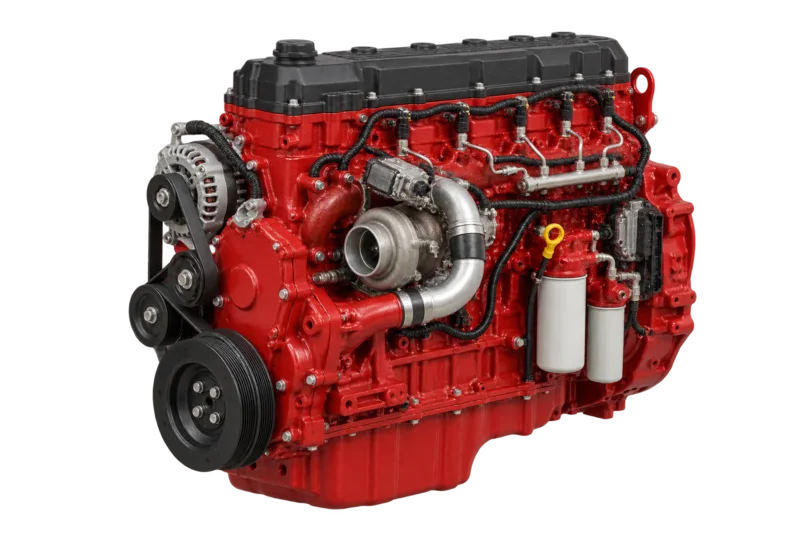
Key specifications
- Displacement
- 8.9 L
- Configuration
- Inline six
- Fuel system
- XPI common-rail diesel on the documented truck builds
- Typical factory output
- Freightliner publishes 260–380 hp for its L9 108SD Plus options, with ratings depending on spec.
- Peak torque
- 860–1,250 lb-ft (2024 truck ratings)
- Governed speed
- 2,100 or 2,200 rpm (2024)
- Dry engine weight
- 1,695 lb (2024)
- Cylinder liners
- Replaceable
Where it was used
This is the 2017-and-later L9 name through the catalog cutoff. The earlier ISL and other engines built around the same displacement were offered under separate designations.
- Freightliner 108SD Plus has Class 8 configurations above 33,000 lb GVWR with Cummins L9 power.
- The L9 is also sold into other on-road weight classes. Confirm the heavy-duty chassis option rather than assuming every L9 installation is Class 8.
Service life
≈680,000–910,000 milesClass 8 diesel rebuild benchmark
In the U.S. EPA rebuild survey, the two averages for Class 8 diesels were about 680,000 miles for a first in-frame rebuild and 910,000 miles for a first out-of-frame rebuild. These are comparison points for the vehicle class. A model-specific overhaul interval could not be verified.
Count idle and PTO hours as well as highway miles. A working vocational truck can reach a high total running time with a modest odometer reading. Investigate oil use, mechanical pressure and coolant trends if the engine is being considered for major work. There is no single published mileage that applies to every L9 duty cycle.
Typical problems and service checks
Supply after a filter service
Check the installed parts and follow the applicable priming procedure when a problem begins immediately after filter replacement. Measured low-side restriction and commanded versus actual rail pressure serve different purposes in this diagnosis.
High temperatures on slow work
A truck may have normal temperatures on the highway and struggle at low speed with a body or PTO load. Document fan request and response and airflow through the entire stack before pricing an engine cooling repair.
Short intervals between regens
Use hours and load history to explain when the filter last had a chance to regenerate. Verify the temperature and pressure signals and the relevant warning sequence. The filter itself may be responding to an engine or operating issue.