Cummins ISX / ISX15
1999–2016
The red ISX family covered several generations of the same job, rather than one engine with a single parts list. Early twin-cam units and later single-cam XPI ISX15s do not share the same injection hardware. That difference matters whether you are looking for a hard start or scheduling an overhaul. Cummins documents its overhaul kits against particular engine configurations, so bring the serial number and CPL to the first discussion.
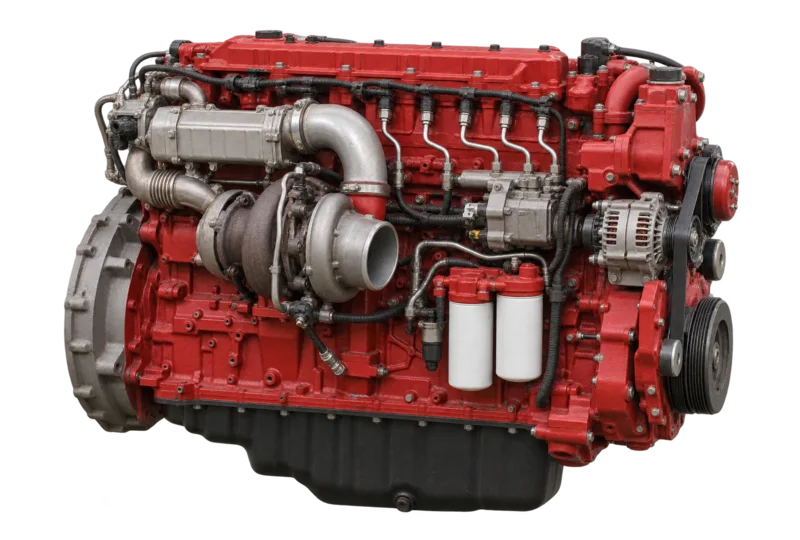
Key specifications
- Displacement
- 14.9 L (15-liter class)
- Configuration
- Inline six
- Fuel system
- Early electronic unit injection; later ISX15 uses XPI high-pressure common rail
- Typical factory output
- Highway and Signature ratings varied by generation. Selected Signature versions reached 600 hp.
- Peak torque example
- Up to 2,050 lb-ft at 1,200 rpm for a certified 2013 ISX15 600
- Aftertreatment example
- Diesel particulate filter and SCR on the certified 2013 builds
- Fuel system generations
- Early, electronically controlled unit injection; later, XPI common rail
Where it was used
Cummins identifies the 1999 ISX era. The coverage ends before the 2017 X15 truck name. Early ISX and Signature parts, EPA10 ISX15 parts and late ISX15 configurations differ.
- Broad North American linehaul and heavy-haul applications in independent-engine Class 8 tractors.
- Cummins documented an ISX supply agreement for International Class 8 and published North American ISX15 truck information for 2013.
Service life
≈680,000–910,000 milesClass 8 diesel rebuild benchmark
U.S. EPA class averages were roughly 680,000 miles for first in-frame rebuild and 910,000 miles for first out-of-frame rebuild. In a separate, manufacturer-reported ISX evaluation, power cylinder parts showed about one quarter wear at 600,000 miles. That test concerned an early North American ISX and did not set an overhaul interval for later variants.
Cummins offers staged overhaul parts for the ISX and X15, but the mileage at which the old engine needs them varies widely. On a high-mileage ISX15, get oil-use and blow-by results, hot oil pressure and an inspection scope before accepting a full kit quote.
Typical problems and service checks
Changes to the high-pressure pump
For relevant XPI engines, identify the installed pump and its service history. If wear material is found, document where it was found and which paths were inspected. A pressure code alone does not establish pump failure or contamination.
Uneven liner or block condition
Before head installation, ask which liner measurements apply to the serial number and block. Prior counterbore or other block work can change the repair plan. Record readings and the cause of any repeated coolant or sealing issue.
Air management and derates
A VGT, charge-air leak, EGR or aftertreatment fault can reduce delivered torque on applicable builds. Verify the original fault and data under the condition that caused it before assigning the problem to the turbo or replacing hardware.
References
- Cummins ISX history
- Cummins North American 2013 engine program
- Cummins ISX/X15 overhaul components
- Cummins X15 introduction
- CARB, MY2013 Cummins ISX15 high-output ratings and emissions equipment
- U.S. EPA, Analysis of Heavy-Duty Engine Rebuild Mileage, Tables 2-10 and 2-12
- Cummins, 2005 ISX high-mileage durability test announcement (syndicated archive)