Caterpillar CT13
2011–2016
The CT13 was the 12.4-liter engine in Caterpillar’s own CT660 vocational program. Its build-specific ratings and exhaust components correspond to that program. Caterpillar documents a dual-series turbo system, a dedicated rating range and cooling-related service procedures. An owner pricing a repair should use the Cat CT13 service reference and engine serial rather than relying on a similar-looking C13 entry from Caterpillar’s earlier highway engine catalogs.
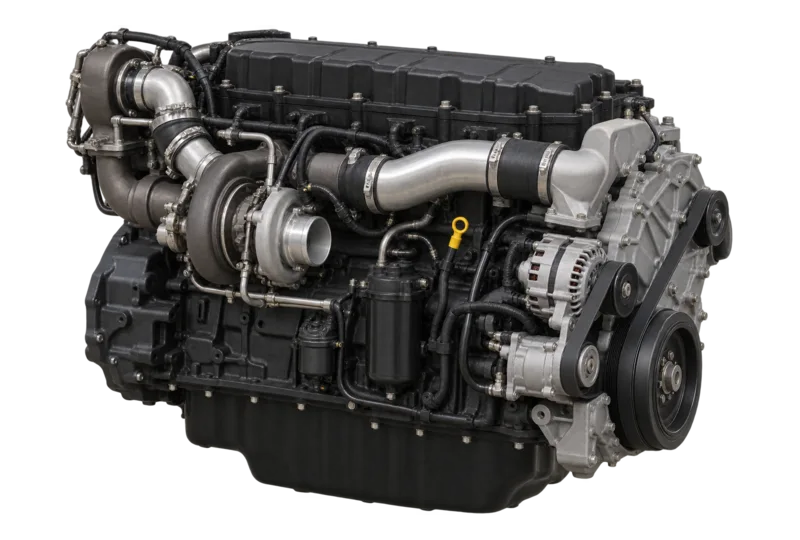
Key specifications
- Displacement
- 12.4 L (758 cu in).
- Configuration
- Four-stroke inline six.
- Fuel system
- Electronically controlled direct diesel injection in the Caterpillar specification.
- Typical factory output
- 410–475 hp across the cited CT660 vocational ratings.
- Peak torque
- 1,450–1,700 lb-ft in the cited Caterpillar CT660 table.
- Bore × stroke
- 126 × 166 mm.
- Aspiration
- Dual-series turbochargers with intercooler and aftercooler.
- Compression ratio
- 17:1 in Caterpillar’s CT13 brochure.
- Engine lubrication system
- 42 U.S. qt (40 L) in the engineering brochure.
Where it was used
Caterpillar lists CT13 among the engines for the Class 8 CT660 at the beginning of the 2011-era program and later in its CT660 product profile. Its 2016 SEC filing states the decision to discontinue on-highway vocational truck production. This directory spans that program, with individual engine and truck dates governed by their labels.
- Caterpillar’s CT660 Class 8 brochure lists the CT13 and ratings for vocational and day-cab applications. Its product literature also documents the CT13 in a later CT660 configuration.
- Select technical documents based on the installed CT13 arrangement and emission hardware. The CAT truck and engine files identify separate replacement and maintenance requirements.
Service life
≈680,000–910,000 milesClass 8 diesel rebuild benchmark
In the U.S. EPA rebuild survey, the two averages for Class 8 diesels were about 680,000 miles for a first in-frame rebuild and 910,000 miles for a first out-of-frame rebuild. These are comparison points for the vehicle class. A model-specific overhaul interval could not be verified.
Use the CT13’s application, operating hours, mechanical inspection and oil and coolant results. Caterpillar states a coolant service interval for a published configuration, which covers maintenance of the coolant.
Typical problems and service checks
Coolant and oil separation
If the oil level rises or coolant disappears, keep a dated record and share both symptoms with the shop. Caterpillar published a diagnostic bulletin for early CT11 and CT13 complaints of coolant entering engine oil.
Dual-series turbo air path
With multiple air stages and heat exchangers, identify the position of a suspected leak or restriction before quoting an assembly. Supply load and engine-speed context and ask what intake and charge-air checks were actually performed.
Application-specific exhaust service
Use the exact CT engine and emissions label when an exhaust warning appears. Preserve the fault information and recent work on the same vehicle. A technician can then check which sensing and aftertreatment equipment belongs to the installed build.
References
- Caterpillar CT13 engineering brochure, performance and dimensions
- Caterpillar CT660 Class 8 technical specifications and applications
- Caterpillar CT660 production information and CT13 engine listing
- Caterpillar CT11/CT13 cooling contamination service bulletin
- Caterpillar 2016 SEC filing on vocational truck end of production decision
- U.S. EPA, Heavy-Duty Engine and Vehicle Standards Regulatory Impact Analysis, Table 2-10