Caterpillar C9
2006
The early ACERT C9 used hydraulically actuated electronic unit injection and turbocharged, charge-cooled air delivery. Two 2006 Freightliner M2 tractors and a Sterling L9500 tractor in the federal VIN database document a Class 8 use for the 8.8-liter version. Caterpillar’s truck catalog also lists a later 9.3-liter C9, which makes the engine serial more useful than the model badge for parts orders. Keep the fuel system arrangement and emissions label with the repair record, particularly when the unit has been replaced.
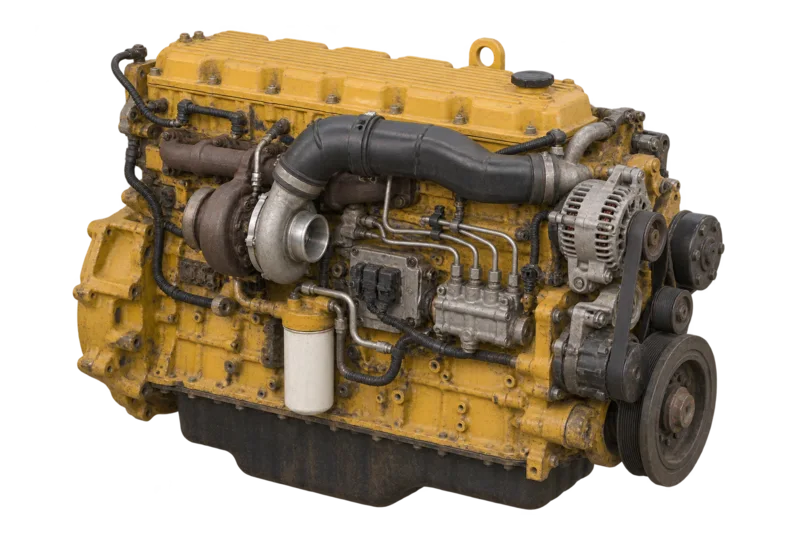
Key specifications
- Displacement
- 8.8 L in the confirmed 2006 trucks. Cat’s truck catalog separately lists a later 9.3 L C9.
- Configuration
- Four-stroke inline six.
- Fuel system
- HEUI-B on early 8.8 L ACERT builds. Check exact arrangement and serial prefix on later engines.
- Typical factory output
- Caterpillar early launch training listed 275–400 hp across applications including RV ratings; 335 hp is documented for the 2006 M2 fifth-wheel tractor listed under VIN 1FUBCYDAX6HV01398.
- Peak torque
- 860–1,100 lb-ft across the early published launch ratings, including RV ratings.
- Aspiration
- Turbocharged and air-to-air aftercooled in early ACERT training and the on-highway recall filing.
Where it was used
Exact U.S. Class 8 highway tractor VIN configurations have been confirmed for the 2006 model year. Separate 2007 California on-highway engine documentation shows a later C9 variant but does not identify a specific tractor in this entry. The directory year is the verified tractor sample, not the lifetime of the C9 family.
- NHTSA decodes 2006 Freightliner M2 VINs 1FUBCYDAX6HV01398 and 1FUBCYDA86HV01366 as Cat C9, Truck-Tractor and Class 8 at 33,001 lb GVWR and above. The first example appears in a U.S. auction record as an M2 106 single-axle day-cab tractor with a 2005 EPA engine label.
- NHTSA also documents the C9 in 2006 Sterling L9500-series Class 8 tractor VIN 2FWBAZDA86AW88761. A period 2006 application establishes a matching tractor configuration and does not imply that every M2 or L9500 received the C9.
Service life
500,000–600,000 milesHistorical heavy-duty rebuild benchmark
In a 1990s EPA study, more fleets expected at least 500,000 miles to first overhaul, and some heavy-duty diesels reached 600,000 between rebuilds. These are fleet benchmarks rather than a rating for this engine.
Use the exact C9 generation, engine hours, oil and coolant history, lubrication pressure and cylinder measurements to plan repairs. No first-overhaul mileage or applicable Caterpillar B50 is established by the cited records.
Typical problems and service checks
Injection pump fit across early ACERT engines
C7 and C9 early HEUI pumps are physically similar, but the C9 uses a different drive ratio and mounting-flange design in Caterpillar’s launch training. Confirm the fitted arrangement and test actuation pressure on the installed C9 before ordering a pump.
Wet-liner and block inspection
The early C9 uses mid-supported wet liners. An overhaul estimate should identify the actual measurements and condition of the block and liner sealing areas. If coolant loss preceded teardown, retain coolant and oil sample results and evidence of external leaks to aid diagnosis.
Fuel dilution on covered C9S engines
Confirm a rising oil level or diesel odor with a sample and check the exact fuel-system arrangement. Caterpillar’s 2007 report identifies a fuel-pump manufacturing defect on specific C9S and C7S serials. Check eligibility and any documented prior repair against that filing.
References
- NHTSA vPIC: 2006 Freightliner M2 Cat C9 Class 8 Truck-Tractor
- NHTSA vPIC: second 2006 Freightliner M2 Cat C9 Class 8 Truck-Tractor
- NHTSA vPIC: 2006 Sterling L9500 Cat C9 Class 8 Truck-Tractor
- Ritchie Bros. U.S. catalog, listed engine and chassis of 2006 M2 106 tractor
- Caterpillar original C7 and C9 ACERT new-product training, mirrored document
- Caterpillar C7/C9 2007 fuel-pump recall report at NHTSA
- California ARB 2007 Caterpillar C9 engine certification
- Caterpillar truck engine reference guide with 8.8 L and 9.3 L C9 entries
- U.S. EPA, Industry Characterization: On-Road Heavy Duty Diesel Engine Rebuilders