Caterpillar C15
2000–2009
Caterpillar’s C15 covered a broad slice of the heavy highway market, from earlier electronic engines to later ACERT and emissions-era builds. It is the same familiar name on parts lists that can describe very different turbocharging, valve actuation and exhaust hardware. Before teardown, record the serial prefix as well as the original complaint. Then tie any cylinder components, turbo or emissions service to the installed arrangement and use the documented fitment of the parts supplier.
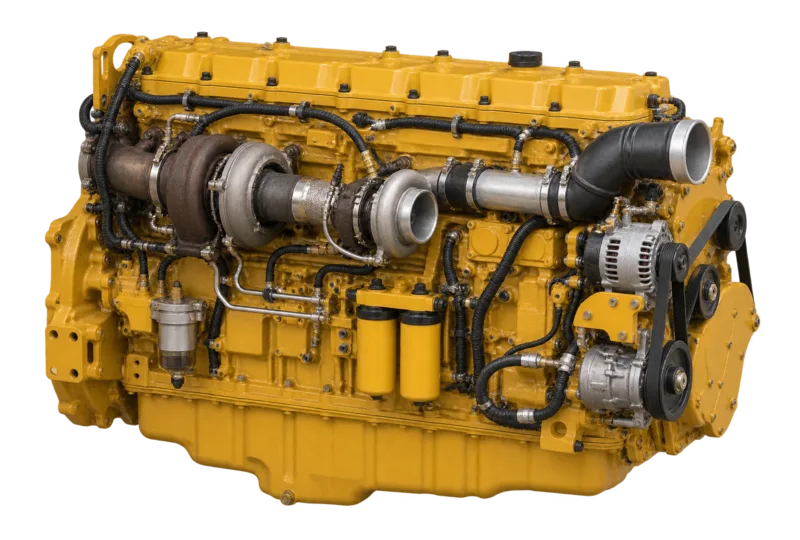
Key specifications
- Displacement
- Approximately 14.6 L for early configurations and 15.2 L for common C15 ACERT builds.
- Configuration
- Turbocharged four-stroke inline six. Turbo and aftertreatment equipment varies by engine build.
- Fuel system
- Electronic unit injection. Control and injector part details vary by generation.
- Typical factory output
- The period range is broad. Caterpillar records a 625 hp highway C15 introduced in 2004, and lower rating options for other truck builds.
- Peak torque
- 1,550–2,050 lb-ft at 1,200 rpm across selected 2006 CARB-certified C15 engine ratings.
- Bore × stroke
- About 5.4 × 6.5 in for the early 14.6 L geometry; Cat lists 137.2 × 171 mm for the 15.2 L ACERT family.
- Aspiration
- Single-turbo early configurations and series-turbo ACERT configurations, with later exhaust packages tied to emissions family.
- Documented high-output example
- Caterpillar records a 625 hp U.S. truck engine introduced in 2004.
- Liner inspection
- Caterpillar documents model-specific liner projection and block measurements for applicable truck rebuilds.
Where it was used
Approximate U.S. on-highway span following the 3406E transition in 1999. It includes earlier C-15 configurations, C15 ACERT and EPA07-era builds. Caterpillar’s announced production cutoff was December 2009 for the then-current U.S. truck engines, and recall filings verify specified 2008–2009 model-year trucks.
- Freightliner’s Columbia operator manual documents C-15 operation. Other truck examples in Cat and chassis-manufacturer filings include selected Columbia and Sterling L-Line installations with certain C13 and C15 engines.
- A heavy tractor should be matched by VIN and installed serial because the same truck model was sold with more than one engine and emissions package.
Service life
714,000 milesFirst overhaul in one owner case
Caterpillar’s Michael Punter profile lists one overhaul at 714,000 miles and more than two million total engine miles. This is one truck and one maintenance history, rather than a model B50.
Measure the condition of the block, liners, oil and coolant and document original faults. An estimate should say which choices depend on inspection and show which external, fuel and exhaust components can be verified for reuse.
Typical problems and service checks
Repeat head sealing failure
Ask for an applicable Cat liner projection and seat inspection before installing a new head or gasket. A later failure after a fresh repair deserves measurement records and a check of the actual block and liner arrangement.
Variable valve actuation oil lines
Caterpillar published a safety campaign for certain C15 truck engines in 2008–2009 trucks. For an applicable build, have a qualified shop review recall status and oil leaks or the relevant line condition using the engine and vehicle details.
Emissions-era warning history
On a DPF-equipped truck, report the exact dash warning and recent service. Get the fault and follow-up results before repeating a regeneration or changing a part. Check the filter mounts where the exact assembly falls under the published campaign.
References
- Caterpillar original C15 truck family history
- Caterpillar SEC filing on its 2010 truck engine market decision
- Caterpillar truck-engine overhaul measurements and liner guidance
- Caterpillar and DTNA DPF retention recall for specified C13 and C15 installations
- Caterpillar C15 variable valve actuation oil supply line safety campaign
- Freightliner Columbia driver manual
- Caterpillar on-highway remanufactured engine and long-block applications
- CARB research report documenting a 2000 14.6 L C-15 Freightliner Class 8 truck
- CARB on-highway engine-family tables documenting later Caterpillar 15.2 L families
- MAHLE North American commercial engine interchange catalog, Caterpillar engine dimensions
- Caterpillar 15.2 L C15 ACERT family dimensions, well-service application (geometry only)
- Caterpillar owner profile documenting a C15 overhaul at 714,000 miles
- CARB 2006 15.2 L truck C15 rating and torque tables