Caterpillar C13
2004–2009
The highway C13 brought Cat’s ACERT technology to the medium-displacement part of its Class 8 range. A later emissions-era truck can have different exhaust hardware than an early C13, so the service procedure should follow the certification and installed engine. Cat also documented a C13 rear engine power take-off replacement arrangement. That is a purchasing detail worth resolving before trying to put a repaired chassis and auxiliary drive back to work together.
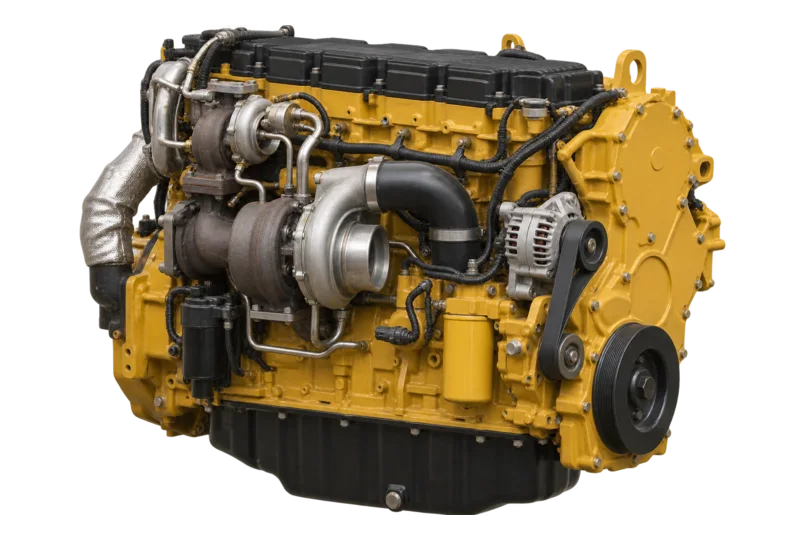
Key specifications
- Displacement
- 12.5 L (763 cu in) in the documented Caterpillar highway specification.
- Configuration
- Turbocharged and charge-cooled four-stroke inline six. ACERT charging arrangements depend on exact build.
- Fuel system
- Electronically controlled direct unit injection for the on-highway ACERT family.
- Typical factory output
- Caterpillar documents a 470 hp on-highway C13 example. Different highway arrangements have their own ratings.
- Peak torque
- 1,450–1,750 lb-ft across Caterpillar’s EPA04 highway C13 examples.
- Bore × stroke
- 130 × 157 mm in the cited Caterpillar C13 on-highway specification.
- Aspiration
- ACERT highway versions use series turbochargers and a charge-air cooler. Other applications differ.
- Peak torque speed
- 1,200 rpm for selected Caterpillar highway rating examples.
- Later exhaust packaging
- C13 and C15 DPF chassis mounts are addressed for certain trucks in Caterpillar’s published safety records.
Where it was used
Caterpillar dates the C13 highway debut to 2004. Specific C13 and C15 EPA07 installations are documented in Cat and DTNA regulatory filings. Caterpillar said it would stop producing its then-current on-highway truck engines at the end of 2009. Check engine build dates separately from truck model years.
- Caterpillar and DTNA filed a U.S. recall covering certain C13 and C15 exhaust assemblies and some Freightliner Columbia and Sterling L-Line installations. Use the engine serial or VIN to establish the specific combination for a truck.
- Cat’s separate C13 road-engine catalog and rear power take-off information support parts identification for highway applications.
Service life
1,000,000 milesCaterpillar B50 for the cited C13
Caterpillar’s on-highway C13 product literature preserved by NHTSA attributes its one-million-mile expected B50 to laboratory testing and disassembly analysis with Caterpillar’s recommended maintenance. The original document discusses 2007 ACERT. Apply the stated design evidence to the version described rather than treating it as a verified first-overhaul result across every early and late serial.
Save the exact engine rating, emission label, cooling and fueling history and any aftertreatment repairs. When planning to overhaul or replace, check the condition of the upstream parts and the aftertreatment or PTO equipment that will remain in use.
Typical problems and service checks
Air-system fault tracking
Record the conditions where boost or power changes. A technician needs the C13-specific arrangement before testing its turbo hardware, charge-air pipes and supporting controls. Track which portion of the air path was actually inspected under pressure.
Later DPF mounting
Check for relevant recall history on a DPF-equipped build, especially where the chassis is known to have a specified affected assembly. A loose or damaged mounting condition calls for qualified inspection and the manufacturer’s instructions.
Rear drive and flywheel housing
If the truck runs auxiliary equipment off the rear engine drive, identify the exact housing and transfer parts before buying an engine. The engine and auxiliary drive need their own verification after a repower or major repair.
References
- Caterpillar history of North American truck engines
- Caterpillar SEC filing on its 2010 truck engine market decision
- Caterpillar CTNA C13/C15 highway filter-retention safety campaign
- Caterpillar C-12 and C13 on-highway and REPTO assemblies
- Caterpillar C13 truck engine parts diagram and model lookup
- Caterpillar technical description of ACERT component changes
- Caterpillar 2007 on-highway C13 product literature in NHTSA docket, PDF pages around the C13 brochure
- Caterpillar on-highway used truck engine quick reference, archived manufacturer publication