Caterpillar C-12
1998–2004
The C-12 occupied a useful middle ground in a highway tractor. It gave fleets Cat electronic diesel power with less displacement than the C15, while specific chassis builders offered their own installation choices. If the engine is being replaced, look at the flywheel housing and any rear engine power take-off before committing to a replacement. Caterpillar documents more than one reman C-12 housing configuration, and the right arrangement matters as much as the fit at the mounts.
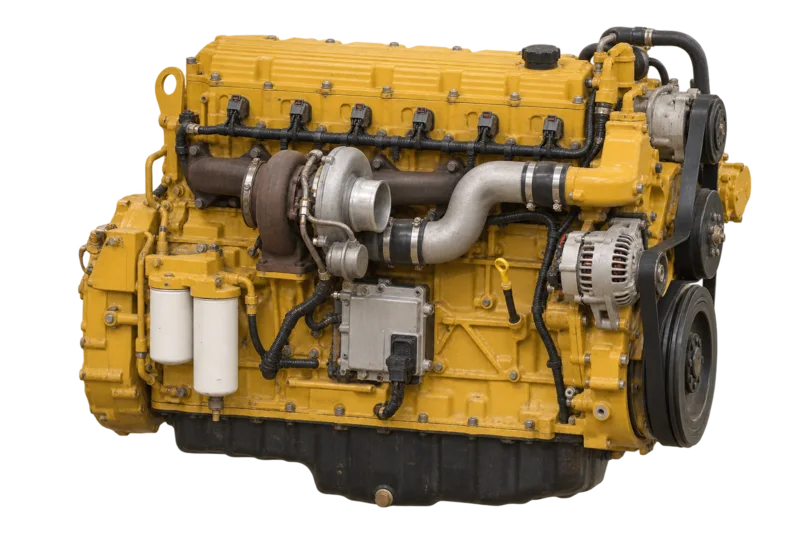
Key specifications
- Displacement
- Approximately 12 L. Check the engine serial and arrangement for the exact displacement and revision.
- Configuration
- Turbocharged and charge-cooled four-stroke inline six.
- Fuel system
- Electronically controlled unit injectors on highway configurations.
- Typical factory output
- Varies by truck, year and engine arrangement. Confirm the original on-highway rating with the Caterpillar serial lookup, rather than borrowing marine C12 figures.
- Peak torque
- 1,350–1,650 lb-ft for 335–430 hp in Caterpillar’s C-12 truck summary.
- Bore × stroke
- 130 × 150 mm family geometry. Verify the highway arrangement before selecting cylinders or overhaul parts.
- Aspiration
- Turbocharged with charge-air cooling in the cited highway layout.
- Flywheel housing variants
- Caterpillar documents both standard and rear engine PTO reman arrangements.
- Engine calibration lookup
- Use the installed engine serial and arrangement, then resolve the truck specification separately.
- Catalog dry weight
- 2,070 lb in the Caterpillar highway quick reference.
Where it was used
Approximate late-1990s to early-2000s U.S. highway window, anchored by Freightliner documentation and the subsequent C13 introduction in 2004. Cat still supports C-12 on-highway repair and remanufacture. C12 engines for marine or industrial use have separate applications and specifications.
- Freightliner’s Columbia driver manual includes Caterpillar C-12 operating information. The manual covers multiple factory engine choices, so confirm the option for a particular tractor.
- Caterpillar documents both standard and rear engine power take-off C-12 replacement arrangements for trucks.
Service life
500,000–600,000 milesHistorical heavy-duty rebuild benchmark
In a 1990s EPA study, more fleets expected at least 500,000 miles to first overhaul, and some heavy-duty diesels reached 600,000 between rebuilds. These are fleet benchmarks rather than a rating for this engine.
Evaluate fuel, oil and coolant records alongside the current measured engine condition and previous repairs. Include auxiliary equipment and responsibility for testing it when a REPTO-equipped engine is replaced.
Typical problems and service checks
Rear power take-off
Identify the existing housing and rear drive by physical inspection before buying a reman engine. Ask the vendor what the supplied configuration includes, what must transfer, and which shop will verify the auxiliary equipment after installation.
Cylinder contribution and electrical supply
When a miss appears, document temperature, driver report and the relevant injector and wiring tests. An order for a whole set of injectors should carry an explanation of how the technician distinguished fuel supply and electrical faults.
Oil and coolant baseline
After a major repair, ask for repeatable oil and coolant levels and the exact service history. If consumption changes with load, capture the operating conditions. That information helps the shop select the appropriate checks for the chassis.
References
- Freightliner Columbia driver manual
- Caterpillar on-highway C-12 replacement and REPTO options
- Caterpillar C12 example overhaul kit and serial fitment
- Caterpillar on-highway remanufactured engine and long-block applications
- Caterpillar history of North American truck engines
- MAHLE North American commercial engine interchange catalog, Caterpillar engine dimensions
- Caterpillar C12 OEM family geometry (marine application, dimensions only)
- Caterpillar on-highway used truck engine quick reference, archived manufacturer publication
- U.S. EPA, Industry Characterization: On-Road Heavy Duty Diesel Engine Rebuilders