Caterpillar 3408
1978–1985
Caterpillar’s 3408 put a physically wide V8 engine in select heavy tractors. Cat’s trucking history highlights it beside the 3406, and a manufacturer profile records a 3408-powered Peterbilt working in U.S. coal haulage. Today a surviving 3408 may have been rebuilt more than once. Component identity, the chassis installation and cooling under load are more useful to the next mechanic than an assumed specification based only on the V8 name.
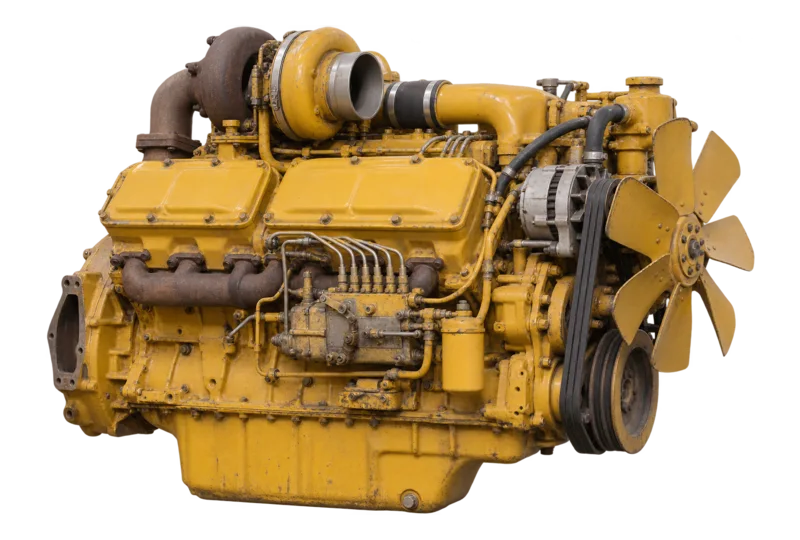
Key specifications
- Displacement
- About 18 L in the 3408 V8 family. Read the engine’s highway arrangement for its exact original specification.
- Configuration
- Four-stroke turbocharged V8, with charge-air arrangements according to build.
- Fuel system
- Mechanical injection pump and individual injectors on period truck arrangements.
- Typical factory output
- Depends on the road-engine arrangement and original rating. Verify with Cat using the build and serial because non-road 3408 ratings vary widely.
- Peak torque
- Confirm the original truck rating by engine arrangement. Marine and industrial curves are application-specific.
- Bore × stroke
- 5.4 × 6.0 in, nominal in the 18.0 L V8 layout.
- Aspiration
- Turbocharged. Charge-air arrangements differ among configurations.
- Cylinder layout
- Two four-cylinder banks in the V8 installation.
- Catalog displacement
- 1,099 cu in in the commercial engine dimensional catalog.
Where it was used
This interval marks documented U.S. highway examples from Caterpillar’s owner profile and early-1980s fuel-economy history. Earlier or later production may have occurred. Separate 3408 industrial or marine production followed its own timeline.
- Caterpillar documents a 1985 Peterbilt tractor used for coal haulage with a 3408. Its owner also reports acquiring a truck 3408 in 1978, providing two dated U.S. operating anchors.
- Check the chassis build record for an individual tractor. A 3408 name from a generator or marine catalog does not establish the same installation.
Service life
300,000–400,000 milesHistorical heavy-duty rebuild benchmark
An early-1990s EPA study reported this range between rebuilds for heavy-heavy-duty diesels in its survey. The range describes the vehicles surveyed and is a point of comparison for this engine’s era. Caterpillar documents Harry Stansberry’s 1985 Peterbilt coal-haul 3408 with over two million total miles and two rebuilds. The source does not give mileage at the first overhaul.
Ask for oil and coolant use, the exact duty and temperature history, prior teardown findings and the parts or measurements from each major rebuild. A lifetime truck mileage figure can include multiple overhauls.
Typical problems and service checks
Cooling at low road speed
A loaded slow climb can expose a cooling issue that is invisible in the yard. Give the shop the actual gross weight, road speed and ambient conditions. The radiator, fan and installation deserve their own inspection.
Bank-specific leak evidence
Take note of which bank and location show oil or coolant residue while the truck is parked safely. Find out whether the shop traced the origin before quoting major work, especially after a long operating interval.
Replacement assembly fit
Have the supplier identify a highway engine or list the parts that need to move from the old installation. Ask about mounts, cooling, driveline interfaces and certification before pricing a build advertised under the broad 3408 name.
References
- Caterpillar owner profile documenting a 3408 Peterbilt
- Caterpillar trucking history and 3408 highway use
- Caterpillar truck-engine overhaul measurements and liner guidance
- MAHLE North American commercial engine interchange catalog, Caterpillar engine dimensions
- U.S. EPA, Heavy-Duty Engine Rebuilding Practices