Caterpillar 3406 mechanical
1975–1995
The early 3406 put a large Cat inline six into a wide range of U.S. tractors. Period records show multiple pumps, fuel ratings and charge-air arrangements even within a single model year. Identify the 3406, 3406B or 3406C hardware on the truck before applying a familiar setting or assigning a parts kit. Some later 3406 pump systems used electronic control. The catalog entry and the parts actually fitted matter whenever the engine has a long repair history.
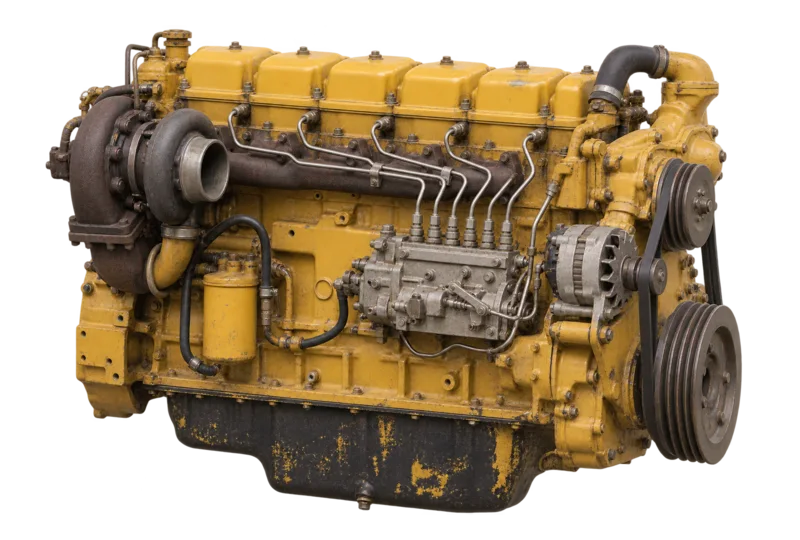
Key specifications
- Displacement
- 893 cu in, about 14.6 L in the 1976 certification. Later configurations should be checked by serial.
- Configuration
- Turbocharged four-stroke inline six, with charge cooling on applicable builds.
- Fuel system
- Mechanical pump, high-pressure lines and individual injectors for the versions covered. Some later variants used PEEC control of pump equipment.
- Typical factory output
- The 1976 CARB documents show rated examples from 255 to 325 hp in particular configurations. Later factory ratings vary by model and arrangement.
- Peak torque
- 1,015 lb-ft in one Federal Register 325 hp 3406 example. Caterpillar lists 1,450–1,650 lb-ft in its 3406C highway examples.
- Bore × stroke
- 5.4 × 6.5 in in the cited 14.6 L mechanical layout.
- Aspiration
- Turbocharged, with aftercooling on applicable certified arrangements.
- Rated power speed
- 2,100 rpm for the certified 325 hp 1976 examples.
- Factory combustion equipment
- Period Kenworth approvals distinguish direct-injection and precombustion arrangements.
Where it was used
The 3406 family appeared in the 1970s. CARB documents 1975 Kenworth and 1976 Caterpillar configurations. The mid-1990s upper boundary represents the approximate transition to the 3406E. Check the engine’s serial prefix and pump to distinguish mechanical 3406C configurations from PEEC and later electronic variants.
- CARB’s model-year 1975 Kenworth listing includes multiple 3406 packages, including direct-injection and precombustion versions. That documents the choices available on its heavy-duty vehicle line.
- Class 8 vehicles of the era often changed engines during service. The engine tag and pump hardware remain the appropriate way to establish the actual specification.
Service life
1,000,000 milesHistorical 3406B field demonstration
Citing the Cat 3406B by model, Chevron’s Delo timeline reports an earlier million-mile no-overhaul example and lists the 3406B in a 1996 group of named models demonstrated at one million miles to overhaul. Caterpillar’s separate Pierre Tanguay story describes a 3406B reaching 35,000 engine hours and gives an estimated mileage equivalent. The 3406B demonstration does not establish a fleet mean or apply to every mechanical 3406, and the hours conversion is excluded as observed mileage.
A clean record of oil use, coolant, pump service and previous cylinder work can help a shop decide when to investigate or overhaul. Use measured block and liner condition to set the rebuild scope.
Typical problems and service checks
Fuel-pump setup
Start with the exact engine, governor and pump. A prior change to the pump or injection hardware can alter how it should be diagnosed. Request the applicable timing and fuel-system checks from a qualified Caterpillar technician.
Air and exhaust condition
When boost falls or smoke changes under load, provide the working conditions and ask which air or exhaust checks were made. A mechanical fuel-setting change can mask evidence of an airflow fault and complicate the diagnosis.
Liner seats after head trouble
A repeat gasket leak merits checking liner projection, seats and head condition under the applicable Cat procedure. Get measurements before any external machine work, then again after the work where the service instructions require it.
References
- Caterpillar history of North American truck engines
- 1975 Kenworth CARB certification listing Cat configurations
- CARB original 1976 Caterpillar highway certification
- Caterpillar 3406B truck-engine catalog and diagrams
- Caterpillar truck-engine overhaul measurements and liner guidance
- EPA North American heavy-truck diesel engineering data and 3176 ratings
- Caterpillar 3406 factory service-manual excerpt, archive copy
- Federal Register heavy-duty engine rating table for model year 1977
- Caterpillar on-highway used truck engine quick reference, archived manufacturer publication
- Chevron/Caltex Delo history, Cat 3406B model-specific demonstration
- Caterpillar Pierre Tanguay 3406B working-hours case
- U.S. EPA survey of heavy-duty engine rebuilding practices