Caterpillar 3176
1989–1997
The 3176 gave Cat a lighter electronic engine option for heavy trucks that could do their work with less displacement than a 3406. EPA’s historic engineering comparison shows examples with modest output by later Class 8 standards. Years of rebuild and swap history make a careful parts check worthwhile. Caterpillar’s C-12 and C13 repower guidance recognizes the 3176 as a possible predecessor, with the original engine arrangement and truck application governing fit.
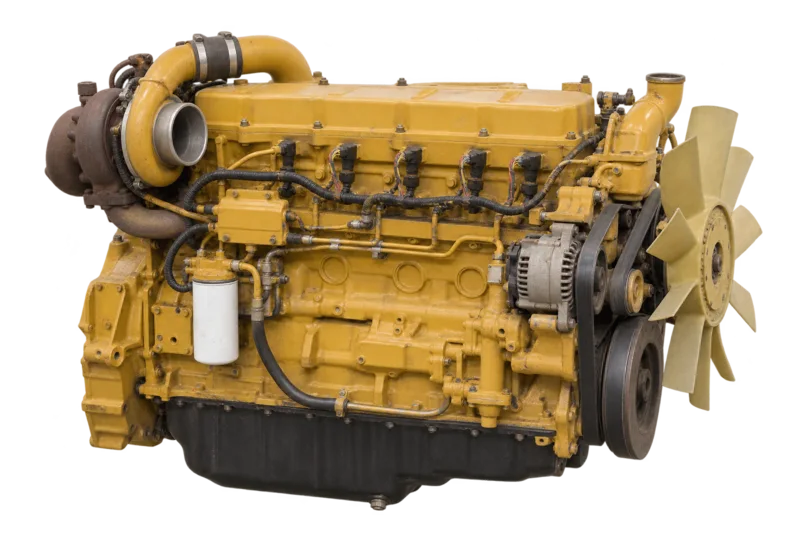
Key specifications
- Displacement
- About 10.3 L for the original on-highway 3176 family.
- Configuration
- Turbocharged and charge-cooled four-stroke inline six.
- Fuel system
- Electronically actuated unit injection on relevant on-highway versions.
- Typical factory output
- EPA’s heavy-duty truck analysis shows 275 hp and 325 hp 3176 examples in its period comparison.
- Peak torque
- Approx. 1,250 lb-ft for the 325 hp example, calculated from EPA’s 300 psi peak-torque BMEP and 629 cu in.
- Bore × stroke
- Approx. 4.9 × 5.5 in, rounded in MAHLE’s commercial-engine index.
- Aspiration
- Turbocharged with charge-air cooling.
- Documented tractor rating
- 325 hp in a 1990 Freightliner Conventional Class 8 emissions test vehicle.
- Displacement in catalog
- 629 cu in in the cited original 3176 application.
Where it was used
Approximate late-1980s through 1990s U.S. highway period. A 1990 Freightliner Conventional tested in the U.S. and EPA’s 1991 model comparison provide dated examples. Caterpillar treats the 3176 as an earlier application in its C-12/C13 replacement guidance. Assembly coverage and transition timing vary by original vehicle.
- In Table B-2 of a U.S. on-road emissions study, a 1990 Freightliner Conventional Class 8b tractor is listed with a 325 hp Caterpillar 3176. Compare the vehicle and engine tags on a surviving tractor to confirm its installed configuration.
- Cat treats the 3176 as an earlier truck application in its C-12 and C13 repower guidance. Confirm the actual arrangement and transfer parts before planning a replacement.
Service life
500,000–600,000 milesHistorical heavy-duty rebuild benchmark
In a 1990s EPA study, more fleets expected at least 500,000 miles to first overhaul, and some heavy-duty diesels reached 600,000 between rebuilds. These are fleet benchmarks rather than a rating for this engine.
Use documented oil and coolant trends and inspect current mechanical condition against model-specific information. Determine whether the recommendation concerns rebuilding the installed engine or pricing a verified replacement also suited to the truck.
Typical problems and service checks
Injector harness and control
Save the operating conditions and active or stored information from a poor-run event. Ask for the checks the technician used to scope the supply, injector and harness. Record the exact 3176 build used by the parts counter.
Correct core and kit
Before opening the engine, ask for the compatible options by serial and arrange to review the removed parts before confirming reuse. A retrofit sold for a 3176 application may involve a different housing or transfer list.
Air and cooling interfaces
An older truck may carry a charge-air or radiator arrangement that was changed during a repower. Identify the installed plumbing and test the complaint against that setup before ordering cooling or intake hardware.
References
- EPA heavy-duty truck engine technology analysis
- Caterpillar 3176 family injector catalog fitment example
- Caterpillar electronic control part lookup for supported engine builds
- Caterpillar C-12 and C13 on-highway and REPTO assemblies
- Freightliner FLD conventional driver manual
- EPA-hosted on-road measurement report, Table B-2
- MAHLE North American commercial engine interchange catalog, Caterpillar engine dimensions
- U.S. EPA, Industry Characterization: On-Road Heavy Duty Diesel Engine Rebuilders