Caterpillar 1674
1975
The 1674 was a mechanical Caterpillar highway diesel with 638 cubic inches and a prechamber fuel system. The 1975 California approval lists two calibrations at 2,200 rpm and approves the engine for Kenworth heavy-duty vehicles. An older truck may have had its engine, pump or head replaced several times, so the casting and stamped data matter more than the hood emblem. Fuel timing, cylinder condition and the integrity of the aftercooling system belong in the same early inspection when the service history is incomplete.
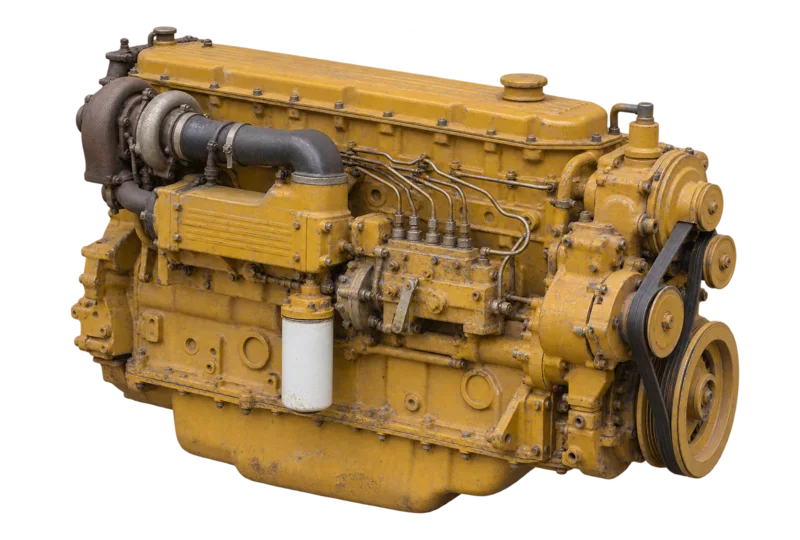
Key specifications
- Displacement
- 638 cu in (about 10.5 L).
- Configuration
- Inline six.
- Fuel system
- Mechanical diesel injection with a separate pump and precombustion chambers in the 1975 state certification.
- Typical factory output
- 255 or 270 hp at 2,200 rpm in the 1975 California tune-up table. Earlier federal model-year records also list a 300 hp test rating.
- Peak torque
- 805 lb-ft at 1,400 rpm for the 270 hp configuration in the U.S. DOT engineering table.
- Aspiration
- Turbocharged and aftercooled in the 1975 engine certification.
Where it was used
The EPA’s federal register documents the 1674 before this directory’s 1975 start. California’s separate Caterpillar and Kenworth executive orders confirm approval for model year 1975, the documented overlap used here. It is a discontinued legacy engine. The one-year directory interval does not identify the global end of production.
- California’s model-year 1975 executive order approves the 1674 for Kenworth heavy-duty vehicles. Gates’ North American vintage heavy-duty application catalog separately pairs the engine with the 1972 Kenworth W900, and a period Kenworth Australian brochure independently lists the 270 hp combination. The 1975 US approval does not name an individual chassis.
- The 1973–79 Ford truck parts and accessory catalog includes the 1674 in its 1973–75 engine-code table as a special order. An original engine plate and build record are particularly useful when the surviving truck has been repowered.
Service life
300,000–400,000 milesHistorical heavy-duty rebuild benchmark
An early-1990s EPA study reported this range between rebuilds for heavy-heavy-duty diesels in its survey. The range describes the vehicles surveyed and is a point of comparison for this engine’s era.
Check the engine identity, oil pressure under comparable conditions, oil use, cooling behavior and available machine-shop measurements before judging overhaul scope. The original specification establishes what engine was approved, while operating records and measurements establish its present condition.
Typical problems and service checks
Precombustion chamber and pump identification
The 1975 tune-up table separates the prechamber 1674 from direct-injected engines in the same document. A cold miss or hard start warrants checks of timing, nozzle condition and cylinder performance with the installed pump and chamber arrangement recorded first.
Aftercooling and smoke under load
Compare smoke and response under a repeatable load and look for restrictions or leakage in the installed boost and aftercooler paths. Use the arrangement-specific cooling layout when tracing moisture or a loss of charge-air performance. Black smoke alone does not establish worn cylinders.
Overhaul parts and core inspection
Record the engine serial, major castings and pump identification before making a parts list. A specialist can then check service data for the exact engine and quote around measured bore condition, crankshaft journals and the repairability of the installed head and chambers.
References
- California ARB 1975 Caterpillar engine approval and tune-up table
- California ARB 1975 Kenworth heavy-duty vehicle executive order
- U.S. DOT engineering report, commercial diesel model output and torque table
- U.S. EPA 1973 model-year heavy-duty diesel certification data
- Gates Vintage Fleet Plus heavy-duty application catalog, 1972 Kenworth W900 engine and belt listing, mirrored manufacturer document
- Kenworth Australia period W-900-series sales specifications, archived manufacturer facsimile
- Ford 1973–79 truck master parts catalog, archived manufacturer edition
- U.S. EPA, Heavy-Duty Engine Rebuilding Practices